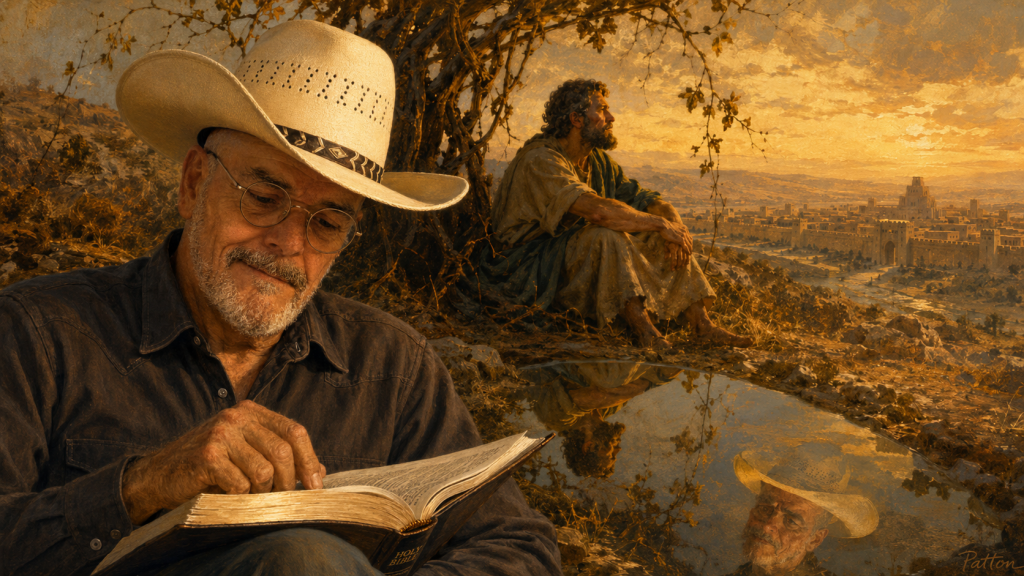
Oh, Jonah. What a hard man you seem to be, so determined to draw the heat away from yourself and aim it toward another.
Yet I am not inside Jonah’s mind. I cannot know every thought that moved through him. From where I stand, however, it looks very much like deflection.
And then the mirror appears.
While I accuse Jonah and come dangerously close to calling him self-serving, am I not doing the same thing as I read the Scripture?
Jonah cries, “Does God not see this dreadful city? Why does He not rain fire upon them and devour them? I cannot bear the thought of mercy being shown to such wretched sinners.”
A hand taps him lightly on the shoulder.
“Excuse me, sir, but you are no angel yourself. In fact, there is something nearly vile in the way you speak of them.”
Then another tap.
This one is for me.
“Braxton, I hate to be the one to say it, but are you not doing the same thing with Jonah?”
Deflecting.
“Wait a dagum minute. I am only explaining that this man is vile and accusing.”
A pause.
“Oh.
Well.
Yes, I suppose I am deflecting.”
I looked again at the page.
“Do these Scriptures not simply tell us what happened? Are they not meant to show us that God was righteous?”
The voice came again, quiet and close.
“Perhaps. They are an accounting of what happened, and yes, they reveal the righteousness of God. But you are forgetting something important.”
“What could possibly be more important than that?”
“The Bible is also a manual for the human soul.”
I waited.
“And sometimes,” the voice continued, “it is best used as a mirror.”
I turned, but there was no one behind me—
Only my reflection, the open Bible, and the uncomfortable suspicion that neither of them intended to let me escape.
I looked down.
There was shame in it, yes, but not only shame.
For the first time, Jonah began to lose the hard outline I had drawn around him. He was no longer merely the accusing prophet, the bitter man beneath the vine, the one who wanted mercy withheld from others while accepting it for himself.
He became human.
Fallible. Angry. Perhaps frightened. Perhaps jealous. Still stubborn, still wrong, still resisting the heart of God, but human all the same.
And once I saw the man, I could no longer speak of him so easily as though I stood above him.
The mirror had done more than expose me.
It had taught me compassion.
With the sting still fresh within me, I returned to Jonah.
Not the caricature I had made of him. Not the hard-faced prophet standing beneath a dead vine, arms folded against mercy. I returned to the man.
He had run from God and nearly carried a ship full of sailors into the deep. He had prayed from the belly of the fish and praised the mercy that rescued him. Then, when that same mercy reached Nineveh, he recoiled from it.
There it was again.
The contradiction—
Jonah could accept grace when he was drowning, but despised it when it lifted another man from the water.
I wanted to be angry with him for that. The anger came easily. It always does when another man’s fault is easier to name than my own.
But the mirror had already found me.
How many times had I accepted forgiveness as though it were bread placed into my own hands, then watched another receive the same portion and wondered whether he deserved it?
How often had I called my own failures wounds, but another man’s failures wickedness?
Jonah sat outside the city waiting for destruction, and I could no longer pretend I had never taken a seat beside him.
Perhaps not beneath a vine.
Perhaps not outside Nineveh.
But I had waited for people to fail. I had expected consequences with a satisfaction I would never have admitted aloud. I had mistaken judgment for righteousness because judgment was falling somewhere other than upon me.
The thought lowered my eyes again.
Jonah was not becoming innocent.
I was becoming less certain of my own innocence.
And perhaps that was the beginning of understanding him.
God asked Jonah whether he had any right to be angry.
It was not the question I wanted.
I wanted God to explain Nineveh. I wanted a list of crimes, a measure of guilt, some assurance that mercy had not come too cheaply.
Instead, God spoke to the heart of the man beneath the vine.
And through the old words on the page, He spoke to mine.
“Do you have a right to be angry?”
I shifted in my chair.
“That depends.”
The answer sounded weak even before it left me.
“Depends upon what?”
“Upon what they did.”
The silence that followed was not empty.
It was waiting.
“And what did you do?”
There are questions that invite an answer, and there are questions that remove every place a man intended to hide.
This was the second kind.
I looked again at Jonah, sitting beneath his withered shelter, angry enough to die over a plant he had not grown and a city he had not learned to love.
For the first time, I did not see only bitterness.
I saw grief twisted into anger. Fear dressed as certainty. A wounded man clinging to judgment because mercy required him to surrender the story he had told himself about his enemies.
Perhaps Jonah feared that if Nineveh could be forgiven, then the world was not as simple as he needed it to be.
Perhaps I feared the same.
Mercy complicates things.
It asks us to see people we have reduced to villains. It demands that we admit a man can be wrong without becoming nothing but his wrongness. It reaches into the ruins, lifts someone we had already buried, and asks us to rejoice.
That is a hard command.
Harder still when the grave had seemed deserved.
I had come to Jonah prepared to judge him.
Instead, I found a frightened, stubborn man being asked to loosen his grip on hatred.
And beside him, beneath the same dying vine, I found myself.
If this piece gave you something to think about, I invite you to pick up your Bible and visit a local Church of Christ.
If you are in the Gladewater, Texas, area, come visit us at:
North Loop Church of Christ
1000 North Loop 485
Gladewater, Texas 75647