Jezebel’s story is found primarily in 1 Kings 16–21, with her death recorded in 2 Kings 9. She enters the biblical account as the wife of King Ahab, one of Israel’s most corrupt kings. First Kings 16:30 says Ahab “did evil in the sight of the Lord, more than all who were before him.”
Jezebel did not merely marry into Israel’s royal house. She brought a worldview with her. She promoted Baal worship, opposed the prophets of the Lord, threatened Elijah after Mount Carmel, and helped turn royal power into a tool of spiritual corruption and personal appetite.
One of the clearest windows into her character is found in 1 Kings 21.
Naboth owned a vineyard near Ahab’s palace. Ahab wanted it and offered to buy it or trade for it. On the surface, that may sound reasonable. A king sees land he wants and makes an offer.
But Naboth refused.
His answer was not selfishness. It was conviction. The vineyard was his inheritance. It belonged to his family line. It carried history, duty, identity, and obedience. Naboth was not merely refusing a real estate deal. He was honoring what had been entrusted to him.
To Ahab, it was a vineyard. To Naboth, it was an inheritance.
That difference matters.
Ahab did not respond with maturity. He went home, lay on his bed, turned his face away, and refused to eat. The image almost sounds childish, and perhaps that is the point. Here is a king with power, wealth, servants, status, and authority, sulking because one man told him no.
Then Jezebel entered the room.
She did not see Naboth’s refusal as a boundary to respect. She saw it as an obstacle to remove.
Jezebel did not tell Ahab to accept the answer. She did not remind him that being king did not make him the owner of every desire. She did not say, “This man has a right to what belongs to him.”
Instead, she mocked Ahab’s weakness and took control.
She wrote letters in Ahab’s name. She used his seal. She arranged a public fast, placed Naboth in a position of visibility, and brought in false witnesses to accuse him. The charge was serious, and the outcome was fatal.
Naboth was killed.
Then Jezebel told Ahab to get up and take possession of the vineyard.
There is something chilling about how efficiently she moved. There was no visible hesitation, no wrestling with conscience, and no acknowledgment that a human life stood between desire and possession.
Ahab wanted. Naboth refused. Jezebel removed Naboth.
That is the machinery of unchecked appetite.
This is not simply a story about one woman’s cruelty. It is a story about appetite with authority, entitlement with resources, and power without restraint. It shows what can happen when a human being wants something and no longer believes another person has the right to stand in the way.
That is where the mirror begins to turn toward us.
Most of us will never arrange a man’s death to take his land. We need to say that plainly. But the pattern beneath the act is not as foreign as we would like it to be.
Have we ever treated someone’s “no” as an insult?
Have we ever decided that another person’s boundary was a personal attack?
Have we ever used influence, pressure, silence, reputation, anger, or manipulation to get our way?
Have we ever made ourselves the victim because someone else would not surrender what belonged to them?
Have we ever wanted something so badly that we stopped caring about what it cost another person?
That is where Naboth’s vineyard becomes more than land. It becomes anything another person has the right to keep: dignity, peace, reputation, body, calling, conscience, story, and the right to say no.
Jezebel’s evil was not only that she took a vineyard. It was that she erased the humanity of the man who stood in the way of desire. Naboth became a problem to solve instead of a person to respect.
That is always dangerous.
Any time a person becomes an obstacle instead of a soul, cruelty has found a door. Jezebel walked through that door without trembling.
The terrible question is not whether we are Jezebel. The terrible question is whether we recognize the first step toward her.
The road to Naboth’s vineyard does not always begin with murder. Sometimes it begins with entitlement, resentment, or the thought, “How dare they tell me no?”
Sometimes it begins with a desire we refuse to discipline. Sometimes it begins when we decide our disappointment matters more than someone else’s obedience.
Ahab’s weakness opened the door. Jezebel’s will walked through it. Naboth paid the price.
That is the warning.
When appetite is given authority, when power serves desire, and when conscience is silenced, someone else’s vineyard is never safe.
Before We Look in the Mirror
Jezebel is easy to hate from a distance, and that may be why her name has lasted so long. She gives us a word for corruption, manipulation, cruelty, excess, and power without restraint.
She is not hard to condemn.
The biblical record does not present her as harmless, misunderstood, or merely unfortunate. Her actions were deliberate. Her influence was destructive. Her hands were not clean.
So let us be clear. This is not an attempt to rescue Jezebel. It is not an attempt to soften her or dress wickedness in better lighting and ask everyone to be more sympathetic.
Jezebel was dangerous.
But if we leave her safely locked in the ancient world, dressed in royal robes and buried under history, we may miss why her story still has merit.
Jezebel is not only a warning about one wicked queen. She is also a mirror, and before we look into that mirror, we must be honest about why we would rather not.
We protect ourselves from old stories by calling them old.
We say, “That was just the way things were back then,” as if cruelty has expired, ambition has learned manners, and power no longer knows how to wash blood from its hands and call itself successful.
Jezebel is not trapped in the past.
Give her a different century and she adapts quickly.
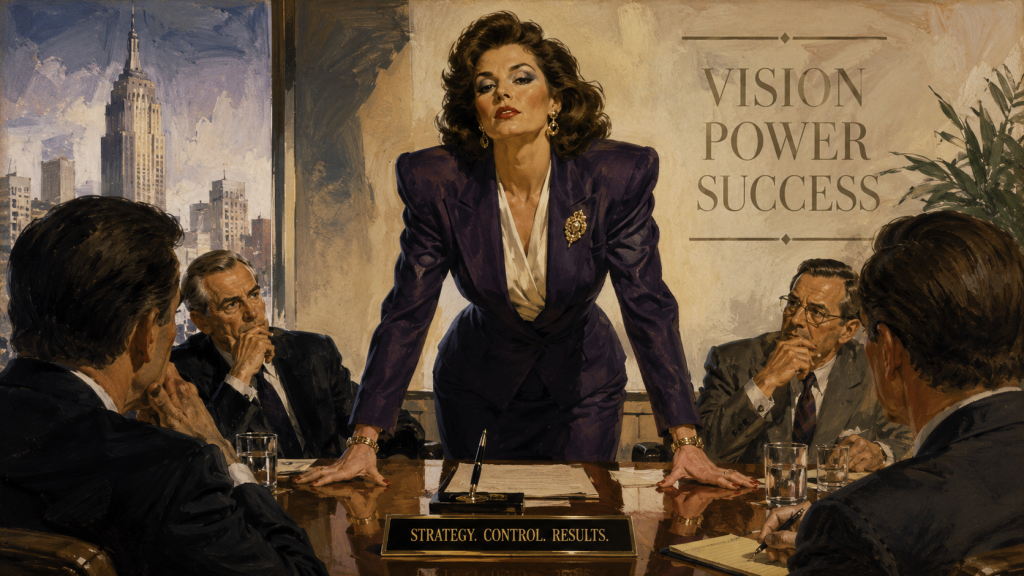
Give her a boardroom instead of a palace. Give her a corporate ladder instead of a throne. Give her a world drunk on image, appetite, acquisition, and applause, and she does not look like a relic.
She looks like someone who understands the room.
There was an entire decade when Jezebel might not have looked out of place at all. We often look back at the 1980s with nostalgia, and some of that nostalgia is fair. The music had muscle. The colors were loud. The hair had its own zip code. The whole thing arrived with a synthesizer and a fog machine.
I am not here to confiscate anybody’s old soundtrack.
But beneath the neon was also a spirit of excess, corporate power, yuppie ambition, and image as identity.
Success was measured by what could be acquired, worn, driven, displayed, or taken over. Greed learned to smile for the camera, and appetite got a business card. People became obstacles, assets, liabilities, or stepping-stones.
That world would have understood Jezebel better than we may want to admit.
Not because everyone in it was evil. That would be too easy and too dishonest.
But the spirit of the age knew something Jezebel knew:
Take what you want, rename it success, and crush what resists.
We do not have to stop in the 1980s.
We can move closer.
We can look at our screens, our platforms, our influencers, and our polished little kingdoms of attention.
Not all of them. That needs to be said plainly. There are people using their voices with honesty, humility, humor, education, and purpose. There are people doing real good in public spaces.
There are also places where vanity has learned to preach, control has learned to smile, and manipulation has learned to call itself strategy.
Perceived power may not be real power, but it can still intoxicate the person holding it.
A follower count can become a throne if the heart wants one badly enough. A platform can become a palace, and a comment section can become a court. Then suddenly the self becomes a kingdom.
That is where the slope begins.
Most people do not wake up one morning and decide to become cruel. They slide: one compromise, one performance, one appetite fed and defended.
One moment when the mirror is avoided because the image on the screen looks better.
One small decision to treat another person as disposable because they interrupted the story we were trying to tell about ourselves.
Then another.
And another.
Somewhere near the bottom of that slope, the mirror finally appears. The person looking back says, “I would never do such a thing.”
But they did.
That is the truth we keep trying to dodge.
Jezebel must be handled carefully because her story is not only about Jezebel. It is about civilization. It is about what happens when appetite is not restrained, power is not questioned, image becomes more important than truth, and the human heart starts calling its worst impulses leadership.
Every one of us carries pieces that must be watched. Some need to be trained. Some need to be denied. Some need to be locked away and never handed the keys.
This does not mean everyone is secretly Jezebel.
It means every human being is capable of becoming unrecognizable when desire is fed without accountability.
That is an uncomfortable lesson.
Jezebel is not dangerous because she was inhuman.
She is dangerous because she was terribly human.
She wanted. She ruled. She arranged. She silenced. She took. She knew how to move people around the board.
She understood influence, fear, and weakness, and she used all of it.
That is what excess does when it is not restrained. It does not stay in one room. It spreads into leadership, worship, marriage, government, business, public life, and even private thoughts.
It tells the soul, “You deserve this.”
Then it tells the conscience, “Be quiet.”
By the time Naboth’s vineyard enters the story, Jezebel’s heart is not wrestling with right and wrong. It is calculating a route.
Ahab wants something. Naboth says no. Jezebel removes the no.
That is the horror of it.
Not only the murder, though the murder is horrifying. The horror is how cleanly she moves from desire to destruction.
No trembling.
No pause.
No visible struggle.
Just the machinery of entitlement doing its work.
This is where the mirror comes close enough to make us uncomfortable.
Have we ever called control love, pride conviction, greed ambition, cruelty honesty, or excess a blessing?
Have we ever told ourselves the outcome justified the means?
Have we ever silenced the part of us that said, “This is wrong”?
That is where Jezebel stops being a figure from the past and becomes a question in the present.
The old stories are not relics sitting behind museum glass. They are alive because human nature has not changed as much as we pretend.
Our clothes changed.
Our tools changed.
Our language changed.
Our platforms changed.
But the mirror did not.
Jezebel stands in Scripture as a warning, not so we can point at her from a safe distance, but so we can recognize the terrible distance a human being can travel when nothing inside them is told no.
The point is not to look at Jezebel and say, “There she is.”
The point is to look long enough, honestly enough, and carefully enough to ask where her path might begin in us.
Most of us will never sit beside a king, sign royal letters, arrange false witnesses, or take a vineyard through blood. Most of us will never have that kind of authority, access, or opportunity.
But Jezebel does not begin with a crown.
She begins with permission.
Permission to want without restraint.
Permission to rule without humility.
Permission to speak without conscience.
Permission to take without reverence.
Permission to silence whatever stands in the way.
The frightening thing about Jezebel is not that she was some strange creature from an ancient world. The frightening thing is that her path is built from materials we still recognize: appetite, image, control, resentment, entitlement, power, fear of being denied, and the hunger to be obeyed.
Those things do not need a palace to survive.
They can live in a home, a church, a workplace, a government, a platform, a marriage, a ministry, a friendship, or a heart.
That is why Jezebel’s story still matters.
Not because we need another villain to hate, but because we need another mirror to endure.
The old stories stand in front of us and ask what happens when appetite is never corrected. They ask what happens when influence has no humility, when power is given to a heart that refuses examination, and when a person is told no and decides the problem must be the person who said it.
Those questions are not ancient.
They are alive.
They are current.
They have Wi-Fi, offices, pulpits, passwords, family dinner tables, and names written close enough to make us uncomfortable.
So perhaps the mercy of Jezebel’s story is not that we can stand above her.
Perhaps the mercy is that we can see the first steps before they become a road.
We can notice when appetite gets loud.
We can notice when resentment starts building a case.
We can notice when our words become weapons.
We can notice when someone else’s boundary makes us angry.
We can notice when we want the vineyard badly enough to stop caring about Naboth.
And when we notice, we can stop.
We can repent.
We can turn.
We can change course.
We can tell the truth before the lie gets organized.
We can hand the keys back before the locked room opens.
Jezebel is not here to be rescued, softened, or excused.
She is here as a warning.
A severe one.
A necessary one.
Because somewhere inside every human being are pieces that must be watched, trained, denied, or locked away from power.
The point is not to look at Jezebel and say, “There she is.”
The point is to look long enough, honestly enough, and carefully enough to ask:
Where would she begin in me?
Final Note
When I first began writing this, Jezebel felt safe.
She was distant enough to study without much discomfort. Ancient queen. Old story. Clear villain. I could examine her without feeling examined myself.
The longer I looked, the less safe the story became.
The mirror did its work.
I saw something I did not enjoy seeing.
I am not Jezebel, but I am human. That means I am not immune to manipulation, pride, control, resentment, lies, or the temptation to move people and circumstances until they serve what I want.
That is not pleasant to admit.
It is easier to keep wickedness dressed in ancient robes and standing far away.
But honesty requires more.
The mercy is that recognition is not surrender.
Seeing the capacity for wrong within myself does not mean I have to obey it.
I still have a choice.
I can stop.
I can confess.
I can turn.
I can refuse to feed what should never be allowed to rule.
If this piece gave you something to think about, I invite you to pick up your Bible and visit a local Church of Christ.
If you are in the Gladewater, Texas, area, come visit us at:
North Loop Church of Christ
1000 North Loop 485
Gladewater, Texas 75647