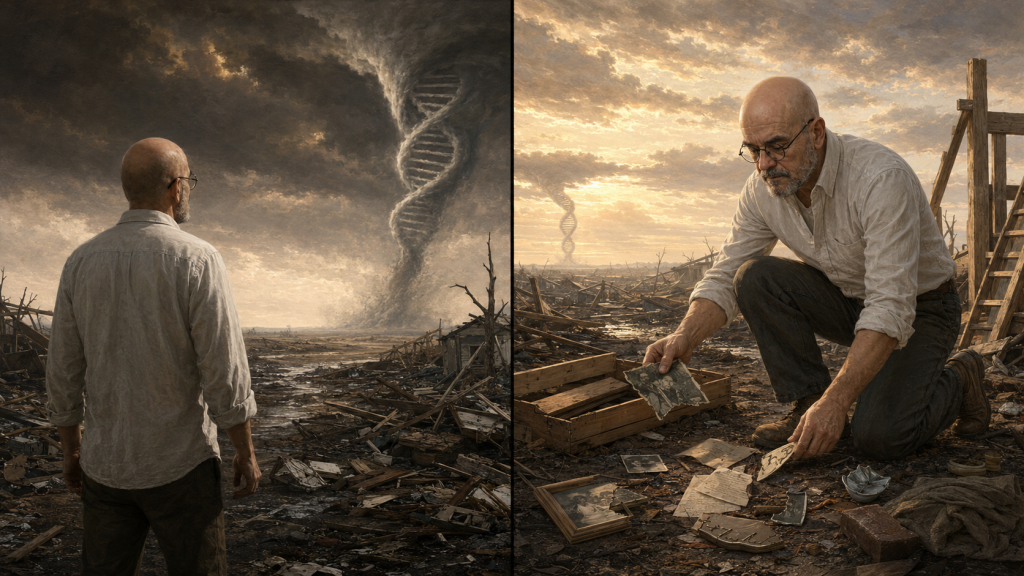
The pandemic was a political time bomb, an emotional nightmare, and a body count all at once.
Those of us in healthcare were standing on the front line of something we did not fully understand yet. It was loud. It was severe. It came with arguments, fear, opinions, numbers, loss, and a constant demand for answers before the answers had finished forming.
But it reminded me of another time.
In the early to mid-1980s, I watched another fear move through healthcare. People were getting sick. There did not seem to be a clear rhyme or reason at first. We did not understand enough about how it was moving. It was fatal, but it was not always fast. It could be slow, brutal, and cruel.
The two moments were not the same, but they carried a familiar shadow.
When medicine does not yet have enough answers, fear rushes in to fill the empty space. Some people deny. Some people blame. Some people sell certainty. Some people go quiet. And some people keep showing up to work because patients are still in the bed, families are still waiting, and someone has to walk into the room.
I learned a long time ago that healthcare is not just science.
It is also witness.
The pandemic gave the world a pause, but not an equal pause. For many people, everything shut down and time became strange. Too much time. Too much screen. Too much fear. Too much quiet.
Healthcare workers did not get that kind of pause.
We got the other kind.
The pause between one hard breath and the next patient.
The pause in the hallway before walking into another room.
The pause where the world was trying to escape, and healthcare was trying to endure.
In the middle of all that, my wife Christina and I decided to do something almost ordinary.
We tried one of those DNA tests.
Some people made sourdough. Some organized closets. Some lost their minds on the internet. Christina and I decided to spit in a tube and ask science who I was.
I thought I might find out whether I had Sephardic Jewish or Ashkenazi Jewish ancestry.
Spoiler alert.
Not Jewish at all.
When the results finally came in, Christina looked at mine first. Then I looked.
Eighty-plus percent Celtic.
I kept going down the list.
Nigerian. I knew that.
German?
A dash of French.
A teaspoon of Italian.
But what I did not see was what I thought I might see. No Sephardic Jewish. No Ashkenazi Jewish. Not Jewish at all.
That should have answered the question, but instead it made the room quieter.
Because now the numbers do not match the story I had been carrying. The test did not give me a clean identity. It handed me a loose thread and dared me to pull it.
Then I noticed a bubble off to the side.
Three close family member matches.
I clicked.
Half-siblings.
Three sisters.
At first, my mind tried to make the old story work. I knew the man I thought was my father had spent time in California. I knew he had been, let us say, active. So, I thought maybe he had fathered more children while he was out there.
Then I looked closer.
I clicked on the first profile.
Her father was listed as Terry Patton.
My heart sank. My first thought was not about me. It was about them. Those poor women. Their lives were about to change. The man they knew as their father might not be who they thought he was.
Then I looked at the second profile.
Terry Patton. Wife one
My heart jumped.
Then the third. Wife two
Terry Patton again. Again, a different wife
That was when the room changed.
It was not their lives that had shifted.
All different named Mothers, and Terry was the only constant.
So, it was mine.
I stopped looking.
I could not breathe right. My heart was racing, and my mind started grabbing at every possible explanation.
Was I switched at birth?
Was I with the wrong family?
Was the test wrong?
Was everything I had been told sitting on sand?
Over the next day or so, I searched for birth announcements from the week I was born. I looked for Patton babies. I looked for anything that would explain why three women I had never known were showing up as close family and all pointing toward the same name.
I thought I had opened a DNA report, what I had really opened was a door.
I wish I could explain what it feels like when your reality bends.
Not breaks at first.
Bends.
There was pressure in my head, a strange tightness, like my mind was trying to hold a door shut while the truth was pushing from the other side. I kept thinking, “This can’t be happening.” Not because I did not understand the information, but because I understood it too well.
I reached out to the three women.
I heard back from one of the ladies daughter Leah. She was kind. Generous. Careful with what she knew. She gave me information I did not have.
I did not know what else to do.
I knew a physician involved in DNA research, so I sent him my results and theirs. I needed someone who understood the science to look at it without family stories, without emotion, without guessing.
His reply was plain.
“In the court system, we call this a slam dunk.”
That was the moment.
It felt like one of those television reveals where the host reads the card and says, “You are not the father.”
Except this was not a studio audience.
This was my life.
My world shattered.
After that, I could hardly look at people in public the same way. I would see a stranger and wonder, “Who are you? Are you one of mine? Are you family? Are you part of a story I still do not know?”
For a while, I almost froze. I could not move forward because the ground under me no longer felt trustworthy. The reality I had lived in was bending so far, I thought it might break.
And at the same time, I was still working in healthcare during full-blown COVID trauma.
The hospital had its own weight then. Fear was everywhere. Patients were sick. Families were scared. Staff were tired in ways sleep could not fix. The world outside was arguing, but inside healthcare, people were still in beds, and someone still had to walk into the room.
And while all of that was happening around me, something else was happening inside me.
I could not stop thinking about the DNA results.
There was pressure in my head. Pain. Heaviness. A constant sense that something inside me was about to give way. I would be at work, surrounded by the noise and trauma of the pandemic, and underneath it all my mind kept circling the same impossible question.
Who am I?
It felt like my reality was bending while I was still expected to function. I had patients to think about, work to do, responsibilities to carry. But inside, the old story of my life was coming apart in my hands.
That is a strange kind of loneliness.
To be surrounded by crisis and still have a private crisis no one else can see.
While all of this was happening, I reached out to a few old family members.
Only one seemed to have any idea who I was.
She told me something that stopped me.
When I was fourteen, I had walked into a room, and she remembered thinking, “Oh my gosh, he is one of those Patton boys.”
Her son had gone to the same school as some of the Patton boys. He knew them. She had seen them firsthand. She knew the look, the family imprint, the way certain people carry a name before they ever know it belongs to them.
I had walked into that room at fourteen with no idea.
But someone had seen it.
Someone had recognized a truth in me years before I was ready to find it.
After speaking with her, I remembered something my mother had told me years before.
She was divorcing her second husband and engaged to another man, the one I had always believed was my father. He was away in boot camp.
During that time, she had a one-night fling with a younger man. I say man, but he was only seventeen.
She became pregnant.
This was 1961. She decided to end the pregnancy and went to someone who was not trained to do it properly. She later said she regretted that decision. Then she would say she had been shown mercy, because just a month later she became pregnant with me.
By then, the man I thought was my father had flunked out of boot camp and was back home.
I came a month early, she said. She told me I was lucky because I was fully formed. Fully formed, what an odd way to put it.
After the DNA results, after the Patton matches, after hearing that someone had seen me at fourteen and thought, “He is one of those Patton boys,” that old story came back to me.
My heart skipped, Terry’s last name was Patton.
The realization hit like a bat upside the head.
What if there had not been a new pregnancy one month later?
What if the first pregnancy never ended?
What if the procedure had failed?
The story I had been told suddenly turned inside out.
She needed to ask for her money back.
The abortion failed.
That is a hard sentence to write.
It is harder to live inside it.
Failed abortion.
Cardiac arrest.
Coma.
Testicular cancer.
Heart attack.
Double bypass.
Cancer.
Chemo.
Immunotherapy.
Abdominal aortic aneurysm repair.
A lung removed.
And I am still here to tell the tale.
Not because I was tougher than everyone else. Not because I had some secret formula. Not because life owed me a clean ending.
I am here because, time after time, the story kept finding one more page.
But before I could build forward, something else had to happen.
There came a final day before the fall.
I knew a mental break was coming. I could feel it. Not as a passing mood or a bad afternoon, but as something imminent. This was the day I was going to break, and I could name it for what it was.
A full mental breakdown.
I stopped at the grocery store to pick up a few things. My legs felt heavy, too heavy to lift. My head was pounding. Inside, I was screaming.
I can’t take this.
Make this go away.
Then the thought came.
Dad is…
A pause.
My ears seemed to perk up, though no one had spoken. Something inside me shifted. The dam was starting to burst.
Dad isn’t Dad.
I started to smile.
Wait.
That man is not my father.
I teared up right there in the store. The dam broke, but not in the way I expected. The relief came because I had finally named it.
Dad wasn’t Dad.
All those things that should not be mentioned. All those things I had carried under that name.
Dad wasn’t Dad.
The world loosened its grip.
He was not my father.
I remember the lights in the store seeming brighter. The pressure began to leave. I had to hurry, pay for my groceries, and get to my jeep.
Then the tears came.
The joy came.
The relief came.
He wasn’t my dad.
He wasn’t my dad.
I was free, dear reader.
For the first time in my life, at age fifty-seven, I tasted freedom.
He was not my blood.
Those things were not done by blood that should have protected me. They were not done by the man whose blood ran through my veins. They were done by someone who had been given a title he should never have been allowed to hold.
Dad was not Dad.
The weight began to leave me.
My breathing slowed.
I could breathe.
I could move.
The past did not disappear. The memories did not erase themselves. But something important changed. The name changed. The place he held in my story changed. The word father no longer belonged to him.
And with that, something inside me unlocked.
I had walked into that store almost broken.
I walked out with air in my lungs.
Anyone who saw me sitting in that Jeep would have thought I had lost my mind.
One moment I was pounding the roof.
The next moment I was laughing.
Then I was crying.
Then my hands were over my face, trying to hold together what had just come apart and been remade at the same time.
But I had not lost my mind.
For the first time, maybe I had found part of it.
I was free.
Not free from memories. Not free from everything that had happened. But free from the lie that had held the wrong man in the wrong place for most of my life, for over half a century.
He was not my father.
Those words did not erase the past, but they opened a door in it.
I sat there in that Jeep with tears on my face, laughing and crying like the pressure had finally broken through the dam.
I was free.
I went home and wrote to my dear niece.
Leah did not know what she had done. She did not know she had used a key that unlocked a prison cell I had lived in for most of my life.
But she had.
And because of that, she is forever embedded in my heart.
After that, I began sending emails to the new siblings. There was so much to understand, so much to ask, so much to explain. I was still trying to stand inside my own new reality, but there was no time to waste.
My sister Leslie was going through her own hell. Her husband had COVID, and he was very sick.
So, I did what I knew how to do.
I tried to answer the questions I could. I explained what we knew about COVID at that time, how it worked, why it was so difficult to treat, and what it meant when someone was placed on a ventilator. I told her what to expect. I tried to help her understand how to react, what questions to ask, and what the medical language meant.
I was in full educator mode.
That is often when I do my best work.
Research. Educate. Build.
Build. Build. Build.
While my own world was still shaking, I started laying down a foundation. I found out I was the eldest of seven, then later more pieces came into view. The family I did not know I had was no longer just a DNA match on a screen.
They were people.
And they needed me. And more importantly I needed them.
That is part of becoming Braxton.
Not a clean reveal. Not a movie scene with music swelling in the background. Not a family tree drawn in perfect lines.
It was a pandemic.
A DNA report.
A slammed door.
An opened door.
A grocery store.
A Jeep.
A niece with a key she did not know she carried.
A sister in fear.
A sick husband.
A new name.
An old wound losing its title.
I sit here today not writing from the mind of a broken individual.
I am writing as Braxton Wayne Patton.
Survivor.
Witness.
Builder.
And owner of a particular fork, one that stays in constant use.
I have not been spared every storm. I have not been handed an easy road. But I am still here, and I know what is mine to do.
So, I picked up the fork.
I took the step.
I did the part that was mine.
And now I take the step that is rightfully mine.
😭