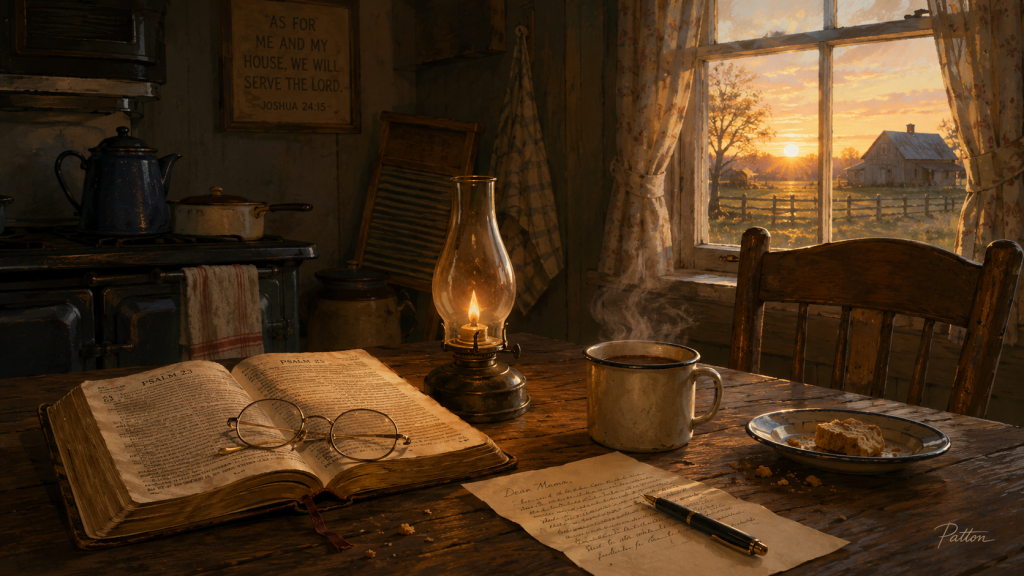
Dear brothers and sisters,
I have been thinking about an old song “O Death.” It has that ancient Holler sound similar to that I grew up with. It is thought to have been written in and around 1902-1910 attributed to Baptist Minister Lloyd Chandler. But more than likely, it is a compilation of laments that were sung across Appalachia.
That song does not scare me the way some folks might expect. I know the words sound dark. I know the song stands close to the grave. But when I hear it, I do not hear a ghost story. I do not hear fear.
I hear memory.
I hear something that might have been sung while Mama hung the warsh out on the line and children chased chickens through the yard. I hear a screen door slap, and I know there is a dog asleep under the porch. O’ I can smell beans simmering, and hear Grandpa sharpening a hoe, and old folks sitting quiet because they knew more than they had words for.
That song does not feel like death coming to take over the room.
It feels like life admitting death has always been nearby, then going right on with the chores.
Maybe that sounds strange, and it is hard to explain. Yes, we are siblings, yet we lived very different lives. I would be more comfortable in a Holler than in a city. (Sorry, I digress.) But there are songs that do not just enter the ears. They find the ribs. They reach down into places that were built before we were born.
That is what I feel when I hear it.
I feel the ancestors’ journey in my ribs, and I feel the fire in the blood pumping through my veins. Not because I lived their story. I did not. Their story belongs to them. Their life belongs to them. Their suffering is not mine to wear like a costume.
But I do believe we were built by what they endured, and we were just lucky enough to be built by it.
I keep seeing it like an old coat folded in a trunk. Not a plain coat. It is an old coat of many colors. One patch carries Appalachia, with its hills, creeks, graveyards, hymns, hard work, and stubborn people who knew how to make do when making do was all there was.
Another patch carries the Ulster-Scots road. The crossing, the grit, and the jaw set against hunger. The weather, trouble, and distance. The part of us that can look at a hard day and say, “Well, it still has to be done.”
And there is another patch, darker and heavier, stitched from the slave ships to Florida. That piece cannot be handled carelessly, because it is not decoration. It is not romance, and it is not something to wave around for attention. This is a sacred, bruised thread. It says somebody endured what should have erased them, and still life came forward.
That is not a small thing.
Maybe we did not all grow up knowing the same stories. Maybe some names were missing. And some doors stayed shut too long. Maybe some of us had to find each other later, after years had already taken what they were going to take.
But blood has a strange way of remembering what paper forgets.
I am not saying we understand it all. I surely do not. I am not saying we carry every detail, every wound, every victory, or every sorrow. Some things belong to the ones who lived them, and we should lower our voices when we get near that ground.
But I do think something made it through. A will to stand, a need to build, and a refusal to quit just because the road got mean.
Maybe that is why “O Death” comforts me. Not because death is harmless. It is not. Not because grief is easy. It never has been. But because the song sounds like people who already knew death was real and still got up in the morning.
These folks, our folks, they washed clothes, fed children, planted crops, and buried their loved ones. They prayed, argued, laughed, and like me, chased chickens and they kept going.
That matters to me.
It matters because I spent too much of my life thinking survival was only about the person still breathing. I am starting to understand survival is bigger than that, bigger than self. Sometimes survival is a line of people you never met, handing forward one more chance.
One more breath.
One more child.
One more name.
One more morning.
One more stubborn soul standing where the storm said nobody should be standing.
We are not self-made.
We are survival-made.
That does not make us better than anybody. It does not give us a crown. It does not excuse our mistakes, and it does not mean we get to sit down and brag about what somebody else carried.
If anything, it gives us a responsibility. We need to tell the truth where we can, be kind where we should, stand up when it is our turn, and to build something that does not shame the hands that stitched us together.
So I am writing this to you, my brothers and sisters, because I think there is a coat in the trunk with all our names on it.
We shouldn’t wear it as pride or wear it as pain. But to remember, somebody before us kept walking. Somebody before us crossed water, hills, fields, grief, hunger, loss, and trouble we may never fully understand.
Somebody before us made it far enough for us to be here, and now here we are.
Still breathing.
Still learning.
Still carrying pieces of stories we did not write but were shaped by all the same.
When I hear “O Death,” I do not hear fear.
I hear the old coat rustling in the trunk.
I hear the ancestors whispering through the seams.
I hear the living and the dead sharing the same porch for a minute.
And I hear something plain and steady:
“We made it this far. Our blood is in you now. Get up and build.”
So that is what I am trying to do.
This old world has turned for ages hand-spun by the Creator. We are only here for a moment, barely a mark on the long page of time. Not even a side note, maybe. But we are here. And that matters.
Maybe the point is not to be remembered by the world. Maybe the point is to learn from what reached us, carry it with a little more care, and leave behind something just a little better than what we found.
If the old ones endured long enough for us to stand here, then maybe our work is simple: pay attention, tell the truth, be kinder than the hurt that shaped us, and build while we still have breath.
Maybe this letter is my way of calling back through the years, to the ones in the hills, to the ones who crossed water, to the ones who were carried where no soul should have been carried, to the ones whose names we know, and the ones whose names were taken, lost, or never written down.
I cannot repay you. I cannot fully understand what you carried. But I can remember with a humble heart. I can speak carefully. I can build honestly. I can try not to shame the life that made room for mine.
I am Braxton Wayne, and I am humbly calling out to the ancestors:
We remember you.
We lower our voices near your suffering.
We lift our hands toward the work.
And with humble hearts, we will build.
P.S. (of course there is a P.S.; it’s a letter to my siblings)
Pick up the fork.
Take the step.
Do the part that is mine.
I find it fascinating about the song, I never really thought about that part–prob not the best take away but it is interesting to me. Do you find it difficult getting up and rebuilding?