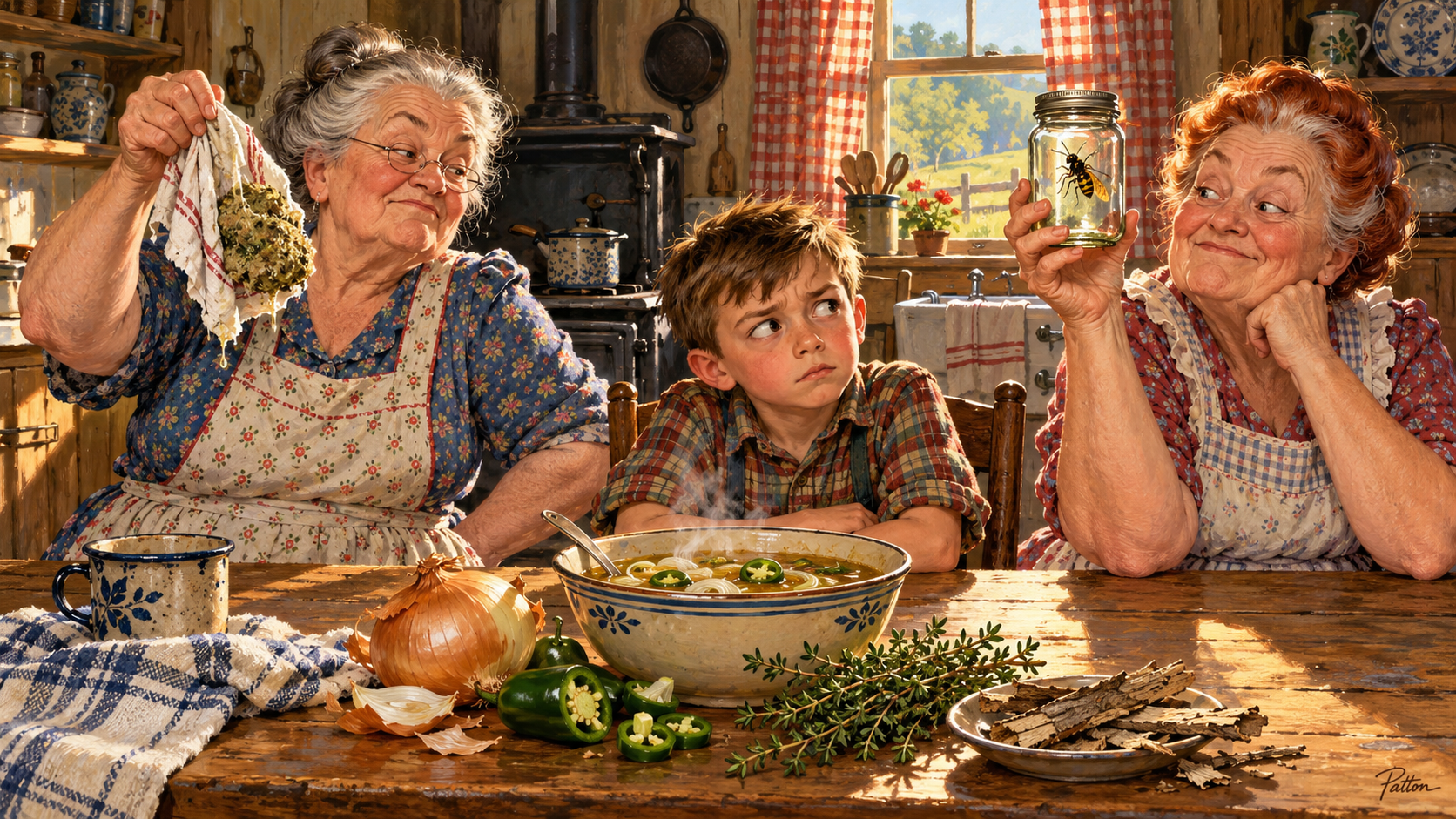
Appalachian Folk Remedies, Jalapeño Cold Cures, and the Hilarious Mystery of How I Survived Childhood

I came home from work with a nose that had apparently decided to irrigate East Texas. After some sleep, I began considering my grandmother’s ten-minute cold cure: jalapeño, onion, and thyme, boiled briefly and left to steep before being served as broth or spicy soup.
Ten minutes was an impressive promise. Looking back, I should have asked whether that meant the cold would be gone in ten minutes or I had ten minutes to get my affairs in order.
There was always an onion involved. Apparently onions had graduated from medical school sometime during the Depression.
That soup, at least, was something you could eat. The rest of the family medical practice required considerably more trust.
One grandmother was Melungeon, a heritage we later confirmed through records. The other was a redheaded Irish woman. Both were reared in Appalachia, and neither seemed troubled by the possibility that the other had a better treatment. I was their shared grandson and occasional testing ground.
Later in life, I learned that my Irish grandmother was my grandmother by adoption. My biological grandmother was Ulster Scots and French, with a story straight out of Louisiana. That’s another story. For this one, the two women I knew as Grandma had already given me plenty to write about.
Take the poultice. Lawdy, what was in that soggy swamp? Somebody had assembled a damp collection of things, wrapped it up, and decided it needed to be strapped to me.
“Hold still. This’ll draw it out.”
Draw what out? The splinter? The fever? A signed confession?
I would have confessed to things I hadn’t even done yet—anything I might get around to by twenty-one, provided I lived that long. Just take the poultice off and bring me a pencil.
Then there were the wasps.
If I got stung, one grandmother applied chewed tobacco and strapped it to wherever the wasp had made its point. Getting stung was bad enough. Now somebody’s used tobacco had become my dressing.
My other grandmother had a different relationship with the insect community. If I had a cold or the flu, she would catch a wasp, put it in a jar, aggravate it, and hold the opening against my skin. The sting was supposed to treat me.
One grandmother was treating wasp stings. The other was prescribing them.
I began to suspect they weren’t sharing medical information.
Somewhere a child was getting tucked into bed with a bowl of soup. I was watching Grandma shake a jar, hoping the wasp might have a stronger commitment to patient care than she did.
I still had the cold. Now I also had a wasp sting and some questions about Grandma.
To this day, I wonder whether those two went around behind the barn and laughed until they had to lean against it.
“What’d you get yours to believe?”
“Oh, these kids will believe anything.”
I also survived willow-bark tea. Other people took aspirin. In our family, somebody went outside and peeled a tree. I didn’t know whether to thank Grandma or apologize to the willow.
And then there was the hair wash for suspected head lice. It left me with minor skin burns and a lasting reluctance to let anybody approach my head carrying a home remedy. Never repeat that one. A childhood memory is plenty; it doesn’t need a demonstration.
People, this was the 1960s. America was preparing to put a man on the moon, while my grandmothers were deciding where to strap the tobacco and whether the medicinal wasp was angry enough.
Somehow our little island had remained trapped in medieval Europe. News of the Renaissance apparently hadn’t made it past the barn.
So when somebody tells me, “Our grandparents didn’t have all this modern medicine, and they did just fine,” I have to wonder who babysat them.
Obviously, it wasn’t my grandmothers.
Nostalgia gets considerably warmer when you weren’t the one wearing the poultice.
These days, when somebody announces a family cure, I lean toward urgent care. But if the doctor walks in carrying a jar with a wasp in it, I’m going to need a second opinion. Preferably from somebody who doesn’t know my grandmother.
Still, here I am, making the soup. Later I’ll grate some ginger and make tea with lemon. There is comfort in a familiar recipe, a warm cup, and the memory of somebody fussing over you. I can appreciate that without reopening the wasp department.
Did all those old remedies work? I honestly can’t recall. I do know I lived, since I’m sitting here typing.
Whether that counts as evidence for Grandma or a testimony to my constitution remains unsettled.
The best thing about childhood may have been surviving it.