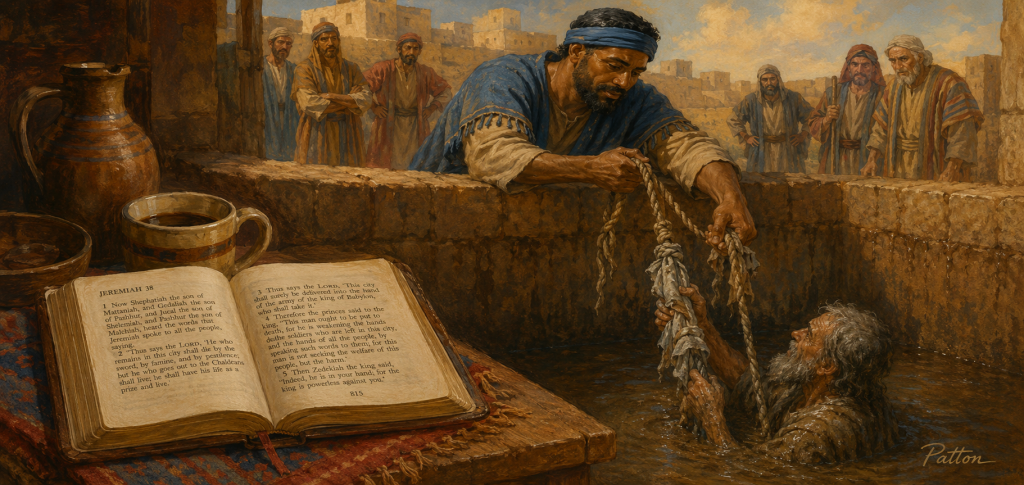
Ebed-Melech shows us that even those who stand outside of “preferred teachings” will be noticed by God. This can be missed or even ignored by those of us who consider others outside our faith to be “less than.”
As we grow older, a few things become true. The senior members of our families begin to pass away. Our jobs change. Our children grow older. And in my case, a stepson was left with a choice to make.
This was mine.
My stepfather could be a difficult man to live with. He could be crass and harsh. He was, however, present. Yes, we argued. We disagreed. But through the years, something shifted between us.
I had always been the strange child, the one people piled things upon when something needed to be done. Perhaps that is why, when the time came, I was the one who remained.
For this story, I will call him “Sam.” It is not his real name. There is no reason to drag every private wound into the open. Even now, I can tell the truth and still allow him some dignity.
Sam was a man who joined our family already in progress. He was a truck driver and, as far as being a provider went, somewhat lacking, to say the least. He could be as stubborn as Balaam, though far less willing to listen than the donkey. His word was final, even when he was plainly wrong and a ten-year-old child could see it.
He wanted the household to operate with military precision, yet he did not live by those same rules himself. As for providing, let us simply say there were times when even Mother Hubbard might have looked into the cupboard and said, “Come on now. This is getting ridiculous.”
This was life with Sam.
The years passed. I grew up, and eventually Sam suffered a heart attack and required a quadruple bypass. He was not the sort of man who took kindly to a physician’s orders. He changed nothing. If anything, he doubled down on the smoking and seemed determined to take his cholesterol each morning with a large glass of buttermilk.
A few years later, the bypass grafts had closed.
By then, I had entered cardiac service myself. Because Sam was family, I was not permitted inside the catheterization laboratory or allowed to participate in his case. I had to remain outside while others examined the damage.
The results were plain: complete blockages.
Sam would need another four bypass grafts.
Nothing changed with time. I told him he needed to follow his physicians’ warnings, but he would not listen. He did not listen to my sister either, though she was one of the wiser members of the cath lab staff and understood cardiac arrhythmias and the circulation of the heart better than most.
During office visits, Sam’s physician would sometimes look toward us and say, “You know what he needs to do.”
That was the wrong thing to say.
If the advice came through us, Sam was almost certain to resist it. And he did.
A few more decades passed. Sam grew old, and the road before him began to narrow. At last, he started leaning on us. Looking back, I do not think he was seeking care as much as comfort. For perhaps the first time, he was not asking to be corrected, managed, or persuaded. He simply wanted someone near.
There I stood at the edge of a precipice, watching the ending of a man I had never truly been close to and knowing his time was drawing near.
How was I supposed to handle that?
I was not especially fond of Sam, at least not in the way we usually speak of affection. Too much history stood between us. Yet as his strength faded, compassion began building within me, slow and unexpected.
The only thing I knew to do was turn to Scripture.
I opened the Bible, and there it was: Jeremiah 38 and the story of Ebed-Melech.
He was not one of the powerful men of Judah. He was a foreign servant, a man standing outside the preferred circle. Yet when Jeremiah had been thrown into a cistern and left to die in the mud, Ebed-Melech saw what others had chosen not to see.
And he acted.
Ebed-Melech went before the king and asked permission to remove Jeremiah from the cistern. Once permission was granted, he acted without delay. He lowered old rags and worn cloths into the pit so Jeremiah could place them beneath his arms before the ropes pulled him upward.
Jeremiah was not Ebed-Melech’s equal in rank or standing, nor was he one of his own people. Yet Ebed-Melech looked into that muddy cistern and did not see a label, a position, or a difference in faith and heritage. He saw a human being who would otherwise starve and die in the mud.
That was enough.
Ebed-Melech stood outside what many in Judah would have considered the favored circle. He was a foreigner, a servant, and not one of the people others might have expected God to notice.
Yet the Creator saw him.
Through Jeremiah, God sent word that Ebed-Melech would be spared when judgment came upon Jerusalem. His courage had not gone unseen. His compassion had not been forgotten. Most importantly, God said that he would be delivered because he had placed his trust in Him.
The outsider had been noticed by God long before the insiders thought to look his way.
After reading the story of Ebed-Melech, I knew the path I needed to take.
It was not paved. It was not merely rocky. It was a dirt road filled with ruts and pockets of mud, the kind of road that forces a person to slow down and pay attention.
My heart began to soften.
During Sam’s final days, I made the coffee strong. We sat together at the kitchen table for hours while he told stories from his years as a deputy and a truck driver, along with memories of his childhood in Houston.
I listened.
Most importantly, we laughed.
I could not repair every wound between us, nor could I pretend the past had been something it was not. But I could look across that kitchen table and see a human being nearing the end of his road.
For that moment, that was enough.
After a few weeks, Sam could no longer rise from his bed. He needed help with everything, including the most private and humbling parts of bodily care.
I did not resist, and I did not allow him to feel less than human.
I kept the conversation light. I made the little jokes when the moment could carry them. I spoke to him as I always had, even as his strength slowly faded.
Then the nurse was called.
She came, and before long, Sam’s journey was finished. The funeral home was notified, and the room grew still.
My final moments with Sam were spent protecting his dignity and preparing him for the journey ahead.
I kept him covered. I cleaned him and dressed him as carefully as I could. There was no argument left between us, no old grievance asking to be answered. There was only one human being caring for another when he could no longer care for himself.
Then it was done.
His final moment, and mine with him, passed with both his dignity and mine intact.
Sometimes God sees us even when we believe we are standing outside. He calls us toward mercy, toward dignity, and toward the right thing in the final moment if we are willing to hear Him speak.
In the beginning was the Word.
If this piece gave you something to think about, I invite you to pick up your Bible and visit a local Church of Christ.
If you are in the Gladewater, Texas, area, come visit us at:
North Loop Church of Christ
1000 North Loop 485
Gladewater, Texas 75647