There is a funny thing that happens as we age. At some point, movement starts getting treated like an extra.
Something for people with matching shoes, gym memberships, expensive water bottles, and enough free time to count their steps like they are collecting trading stamps. (cough, cough, Jammie) wink
I do not see it that way. Movement is not decoration; movement is maintenance.
For me, staying active is part of the same march back to wellness as eating better, drinking water, paying attention, canning food safely, sleeping when I can, and doing the part that is mine.
I am not trying to become twenty-five again. That ship sailed, hit weather, circled back once, and is now probably dry docked somewhere selling tacos.
The goal is not to become young; the goal is to stay useful.
Useful means getting out of a chair without turning it into a three-act drama. Useful means walking across a parking lot without needing a committee meeting.
Useful means carrying groceries, stepping over a curb, going to church, working in the kitchen, playing with grandkids, and still being able to participate in ordinary life.
The word that matters to me is “participate.”
There is a difference between being alive and participating. I am grateful for both, but I am aiming for the second one as long as the good Lord lets me.
Now, I am not talking about foolishness. I am not talking about proving anything. I am not talking about walking into a gym, grabbing something heavy, and letting your joints file a complaint that tells you to give it up already.
Aging is real, folks, but rust is optional.
The body was made to move, and when it stops moving, it starts negotiating against us. Muscles weaken, balance gets lazy, and endurance shrinks. Stairs start getting taller. Chairs get lower, and I’m talking to you, Jeff. The ground starts acting suspicious and untrustworthy.
That does not mean we panic. It means we train for real life.
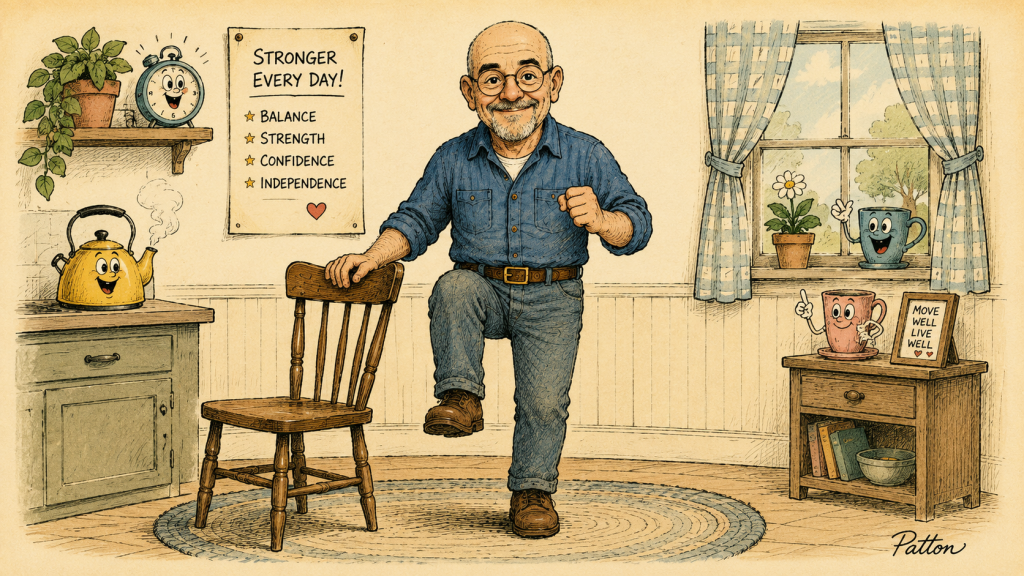
That might look like walking a little more. Standing up from a chair a few extra times. Marching in place near a counter. Doing slow side steps in the hallway. Using a wall for balance. Carrying a light bag from one room to another. Doing counter push-ups instead of pretending the floor and I are still on speaking terms. (ain’t it the truth)
Small movements count when they are done on purpose.
The CDC says older adults benefit from weekly aerobic activity, muscle-strengthening activity, and balance work. That makes sense to me because those are the things ordinary life asks from us, and those not-so-minor things spoke to me first.
Walking asks for endurance, standing up asks for strength, turning, reaching, stepping, and catching ourselves ask for balance.
Life does not usually test us with one big dramatic moment. It tests us with ordinary things such as a curb, a laundry basket, a slick kitchen floor, a low chair, a grandchild moving faster than expected, or the need to carry something while still looking where we are going.
That is why I like simple activity.
Chair. Wall. Counter. Short walking path. Light bands if you have them. A few minutes here and there. Nothing fancy. No performance. No circus music. Just practice.
My rule is simple: “Stop before sloppy.”
Sloppy is where injuries like to hide. When form falls apart, pride needs to sit down and hush. I would rather do five controlled movements today and be able to move tomorrow than do twenty ugly ones and spend the evening negotiating with an ice pack.
Remember, the floor is not the finish line.
Speed has its place, but control comes first. Especially as we age. Especially if we are rebuilding. Especially if we have medical history riding in the passenger seat making comments, and those comments can be loud.
Activity should challenge us, not ambush us, and, yes, some people need medical clearance, physical therapy, supervision, or modifications. That is not weakness. That is wisdom. A good plan should fit the person standing there, not some imaginary version of them from 1987.
Our goal should not be punishment. The goal is preservation of strength, balance, confidence, and independence.
Preserve the ability to say, “I can still do this,” and mean it.
That matters because once we lose function, getting it back can be hard work. Not impossible, but hard. I know something about hard. Hard does not scare me. Wasted opportunity bothers me more.
So I move, not always beautifully, not always eagerly, and sometimes I move like a rusty gate arguing with the sand built up along the bottom.
But I move. I stand. I walk. I march. I use the counter. I stop before sloppy. I remind myself that tomorrow matters.
Being active as we age is not about chasing youth. It is about honoring the body we still have; it is about keeping the doors open as long as we can.
It is about choosing participation over surrender.
Some days that may be a walk.
Some days it may be chair exercises.
Some days it may be carrying green beans across the kitchen like they are part of a sacred training program.
That is fine.
Do what is safe.
Do what is honest.
Do what helps.
Then come back tomorrow and do a little more of the part that is yours.
Helpful places to start: CDC Physical Activity Guidelines for Older Adults, National Institute on Aging Exercise and Physical Activity resources, and your own healthcare provider or physical therapist if you have medical limitations, balance problems, falls, or a complicated health history.