Last Wednesday, our minister asked if anyone had ever counted how many times Paul opened his letters with the blessing or said, “Grace to you and peace from God.”
I had not counted them either. (For the record I count 13.) But the question stuck to me like sawdust on a damp sleeve. So, I went looking. Now let’s get started.
Grace at the Door, Grace at the End
When Paul writes, he often opens the door with a familiar blessing:
“Grace to you and peace from God…”
You see that greeting again and again in the letters traditionally connected to Paul. Romans, Corinthians, Galatians, Ephesians, Philippians, Colossians, Thessalonians, Timothy, Titus, and Philemon all carry that kind of greeting.
That may even seem like a small thing, but small things in Scripture often carry a punch not seen until you are reflecting. Paul does not begin by showing off. He does not start with thunder, argument, or a parade of credentials. He begins with grace and peace.
Now, I want you to notice the order. Grace comes first, and then peace follows.
That makes sense. Peace without grace is just a painted fence over rotten boards. Real peace begins with what God gives, not what we pretend to have. Grace is God reaching toward us. Peace is what begins to settle in the heart when we actively receive what God has given.
In a few places, especially when Paul writes to Timothy, he adds another word:
Mercy. “Grace, mercy, and peace.”
That little word matters. Timothy was carrying responsibility. He was dealing with people, teaching, pressure, weakness, conflict, and the weight of spiritual work. Paul knew leaders did not just need instruction. They needed mercy, and mercy belongs right there in the middle.
Now, Hebrews is interesting. Through the years, some have wondered if Paul wrote Hebrews. Some have disagreed, and Hebrews itself does not name the writer. We do not need to settle that debate right here to notice something helpful.
Hebrews does not begin the way Paul’s letters usually begin. There is no opening, “Grace to you and peace.” Hebrews begins with God speaking:
“God, who at various times and in various ways spoke in time past…” That is not a howdy or handshake at the door. That is the sermon already underway. But Hebrews does end with grace, “Grace be with you all.” So whether grace is standing at the front door, as in Paul’s letters, or waiting at the final line, as in Hebrews, the message remains steady.
God’s people do not outgrow grace.
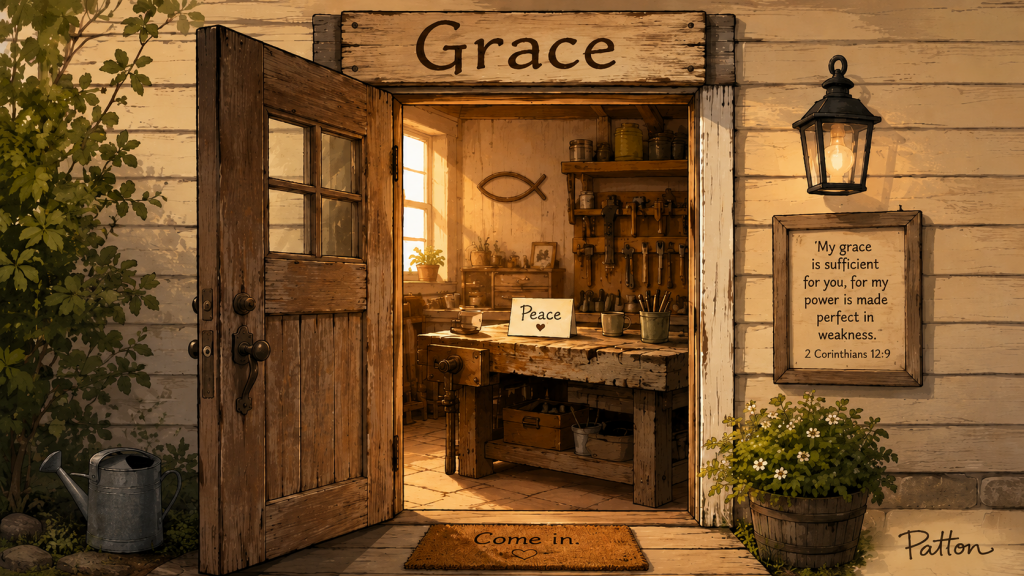
We do not graduate from it. We do not move on to something more impressive. Grace is not the beginner’s tool left on the bench after we become skilled. Grace is the bench, the light above it, and the hand steadying ours while we work.
Paul’s greeting reminds us that grace comes first and peace follows, and Hebrews reminds us that when the sermon is over, when the warnings have been given, when faith has been explained, when endurance has been urged, the last word still belongs to grace.
Now that is something worth carrying: grace at the beginning and grace at the end, and grace for the road between.
I would like to invite you to visit your local Churches of Christ. Tell ’em Braxton sent you.
Y’all have a Blessed day.