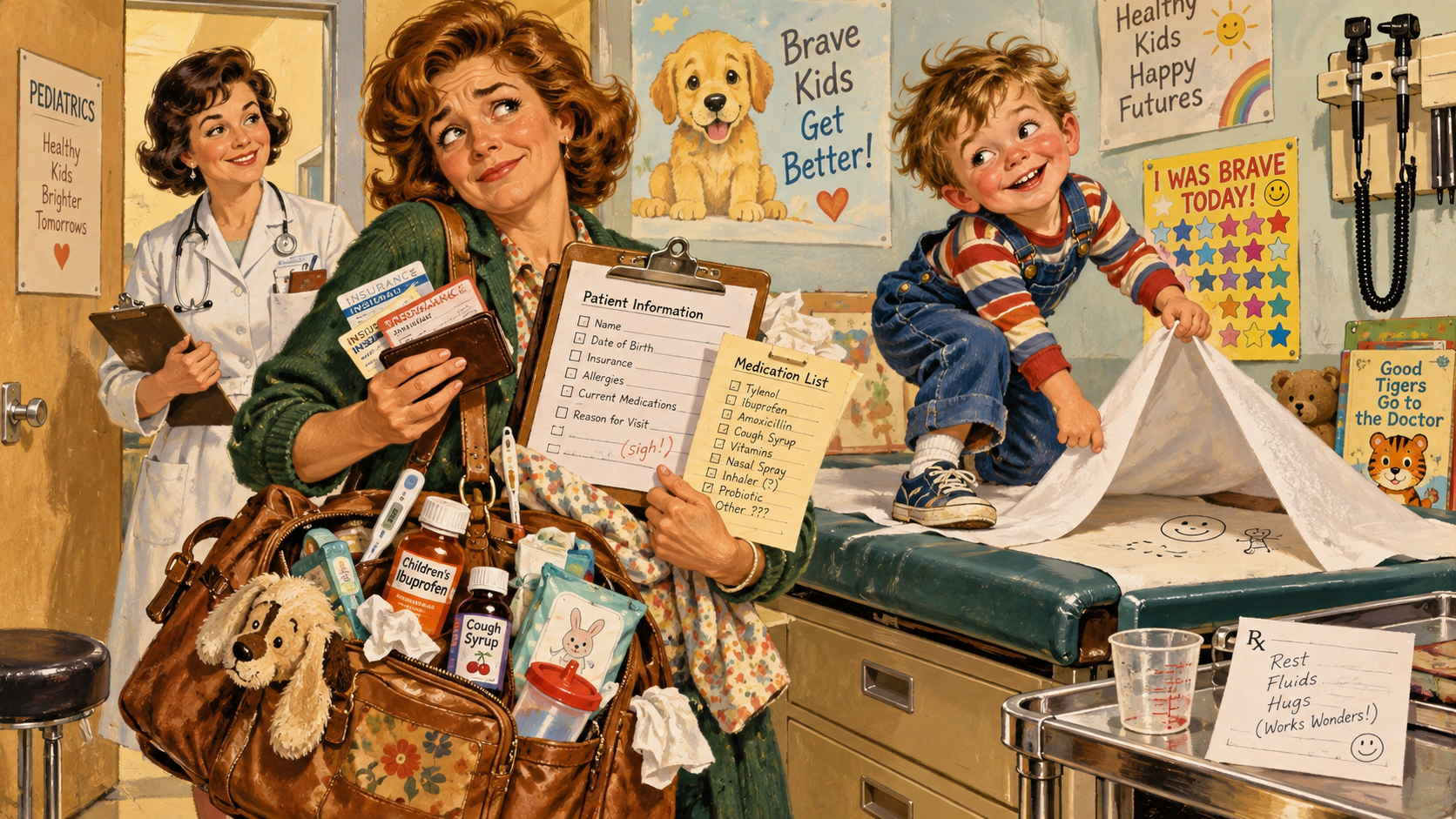
Why Taking Kids to the Doctor is Actually an Extreme Sport (And Other Parental Truths)

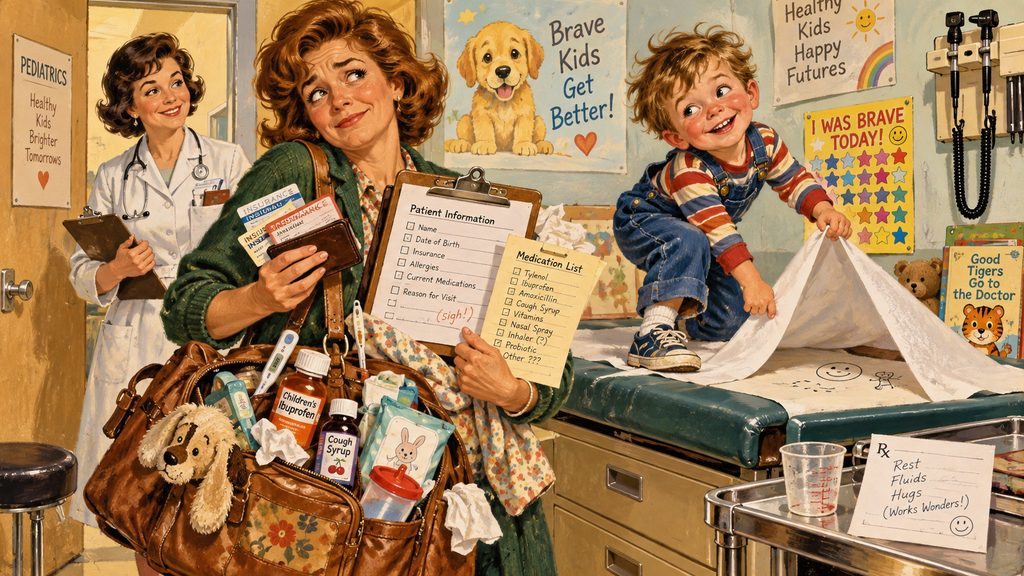
Nobody tells you that taking a child to the doctor requires the same planning as crossing a small mountain range.
You do not simply put the child in the car and go.
No.
First, you must locate the insurance card.
Then the child’s insurance card.
Then the other insurance card that somebody mailed last month because apparently the first insurance card was no longer sufficiently insured.
Then you need the medication list.
“What medications are they taking?”
“Well, there is the pink one, the chewable one, the one that tastes like bubble gum, and something prescribed by a doctor whose name I cannot pronounce.”
Then comes the paperwork.
There are always forms.
Forms asking whether the child has allergies.
Forms asking whether anyone in the family has allergies.
Forms asking whether anyone in the family has ever looked suspiciously at a peanut.
And, naturally, the child is perfectly healthy until you arrive at the doctor’s office.
At home they were coughing like an old tractor trying to start in January.
The minute the nurse walks in, they are healed.
No cough.
No fever.
No pain.
Nothing.
The nurse asks, “What brings you in today?”
You look at the child.
The child looks at you.
“I don’t know. Mom made me come.”
Traitor.
This is the same child who woke you at 2:14 in the morning announcing, “I think my ear is exploding.”
Now the ear is apparently enjoying a full and complete recovery.
You begin explaining symptoms while the child examines everything in the room.
The rolling stool.
The cabinets.
The paper on the exam table.
Especially the paper on the exam table.
There is something irresistible about that paper.
By the end of the visit, the child has managed to turn a six-foot roll of medical paper into what appears to be emergency shelter for a small village.
Then the doctor asks the important question.
“When did the symptoms start?”
Parents are expected to know this.
We do not.
We know it was sometime after Tuesday but before the dishwasher broke.
Maybe Wednesday.
Possibly Thursday.
Definitely before Grandma called.
Then comes the pharmacy.
The doctor sends the prescription electronically.
This is presented as modern convenience.
It means you can now drive across town and arrive at the pharmacy before the prescription does.
“We don’t have it yet.”
“The doctor sent it.”
“Yes.”
“So where is it?”
“We don’t have it yet.”
I have always suspected electronic prescriptions stop somewhere along the way for coffee.
Eventually the medicine arrives.
Then the insurance company enters the story.
“They won’t cover this one.”
“But the doctor prescribed this one.”
“They prefer another one.”
“Has the insurance company examined my child?”
“No.”
“Has the insurance company met my child?”
“No.”
“Does the insurance company know my child once swallowed a marble because he wanted to know what would happen?”
“No.”
“Well, then I believe we have reached an informational disadvantage.”
Eventually you get the medicine home.
Now comes the dosage.
“Give two teaspoons twice daily.”
Easy enough.
Except the medicine tastes terrible.
The child takes one sip and looks at you as though you have betrayed the entire concept of parenthood.
“What is this?”
“Medicine.”
“It tastes bad.”
“Yes.”
“Why does medicine taste bad?”
“Because apparently healing requires suffering.”
Then comes the question every parent eventually hears.
“Do I really have to take it?”
You become part parent, part nurse, part hostage negotiator.
“Yes.”
“I feel better.”
“You have taken one dose.”
“I think it worked.”
“It has been four minutes.”
“I am very healthy now.”
Parents also develop strange medical equipment collections.
Thermometers.
Old inhalers.
Dosing syringes.
Bandages in twelve sizes.
Half-empty bottles of medicine nobody remembers receiving. Oh wait that one was for the dog. I hope I didn’t give my child the dogs medicine. Well at least he will not have fleas.
A humidifier purchased during a respiratory illness that has not been used since 2009 but cannot be thrown away because the moment you throw it away somebody will develop a cough.
And somewhere in every house is a medicine cup with the measurement markings worn off.
Nobody knows why we keep it.
We just do. No need to even think about this once again.
Then, somewhere along the years, something changes.
The child who once screamed because the doctor wanted to look in their ear grows up.
They start making their own appointments.
They keep their own insurance cards.
They fill their own prescriptions.
Mostly.
Then one day the phone rings.
“Mom, do you know what insurance I have?”
And just like that, nature has healed itself.
Because no matter how old they get, somewhere deep inside every grown child is still a kid sitting on an exam table saying,
“I don’t know. Mom made me come.”