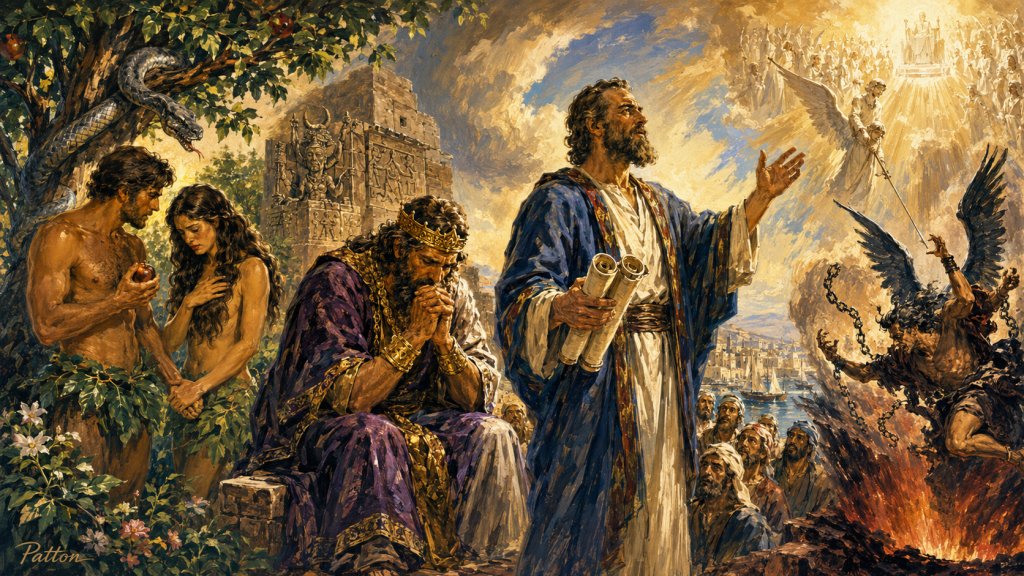
“In the beginning was the Word.”
Before the universe moved, before light broke across the darkness, before water gathered and land rose, the Word was already there.
John begins his Gospel with language that reaches behind Genesis itself:
John 1:1–3
In the beginning was the Word, and the Word was with God, and the Word was God.
Genesis begins with creation, and John begins before creation.
There was no panic in heaven. No hurried repair. No divine uncertainty. God spoke, and creation answered.
Genesis 1:1–3
The darkness covered the deep. The Spirit of God moved over the waters. Then came the command:
Let there be light.
The light appeared, but it did not originate only from the sun, because the sun and moon were not appointed until later. Growing up, this part had escaped me. I had missed that the light was emanating from God himself.
Genesis 1:14–18
The light came from God, and the light has never ceased.
John says:
John 1:4–5
In Him was life, and the life was the Light of men. The Light shines in the darkness, and the darkness did not comprehend it.
The Light shines, not merely shone.
It continues.
There are times when we cannot see the light. Grief clouds it, pride hides it, and fear turns our face away from it. But the light does not cease because we have lost sight of it.
God built creation with order, purpose, and beauty.
Then humanity decided to improve upon the design, and that is where the trouble began.
The First Alteration
God created man and woman in His image.
Genesis 1:26–27
In the garden, the serpent came and offered them another possibility.
They (Adam and Eve) could become like God. They could determine good and evil for themselves.
Genesis 3:1–6
The temptation was not merely about fruit; it was about authority. We as humans want to be in charge.
God had given Adam and Eve life, purpose, relationship, and freedom. Yet they chose to take the design into their own hands.
Adam and Eve were created in God’s image.
They tried to remake life in theirs. The serpent tempted them, but he did not force them.
Adam chose; he made the decision.
Eve chose; she made a decision. This is what we need to remember: “They” made a decision.
And when God confronted them, the excuses began.
Adam blamed the woman and indirectly blamed God:
Genesis 3:12
The woman whom You gave to be with me, she gave me from the tree, and I ate.
Eve blamed the serpent:
Genesis 3:13
The serpent deceived me, and I ate.
Both had been influenced and deceived. Yet both had chosen.
The serpent could offer the road, but he could not make them walk it.
The Gift and Burden of Choice
Choice is one of the greatest gifts God gave humanity, and without choice, love would be programming. Obedience would be machinery; faith would be a track we followed because no other road existed.
God did not make us puppets.
He placed life and death before us and said:
Deuteronomy 30:19
I have set before you life and death, the blessing and the curse. So choose life.
Choice is a gift, but it carries weight.
We may choose what is right.
We may also choose pride, deception, cruelty, bitterness, and rebellion. That right there is so very human.
We may listen to wisdom.
We may ignore it.
We may turn toward God.
We may turn away.
James places responsibility directly upon us:
James 1:14–15
Each one is tempted when he is carried away and enticed by his own lust. Then when lust has conceived, it gives birth to sin; and sin, when it has run its course, brings forth death.
Temptation is real.
Spiritual opposition is real.
But temptation is not compulsion.
“The devil made me do it” may have made a good comedy line, but it does not stand as a defense before God.
The devil may whisper. Pride may persuade, and fear may push.
Others may corrupt, deceive, or infect the thinking of those around them, but no one can sign our name beneath the choice except us.
The Adversary
The Bible gives us several words and images for the spiritual enemy.
“Satan” means adversary or accuser.
“The devil” means slanderer.
Revelation connects the devil with the serpent of Genesis.
Revelation 12:9
The great dragon was thrown down, the serpent of old who is called the devil and Satan, who deceives the whole world.
The name “Lucifer” comes from older translations of language in Isaiah 14 concerning the fallen morning star.
Isaiah 14:12–15
The immediate passage speaks against the king of Babylon, whose pride led him to exalt himself. Through the centuries, many Christians have also heard within those words an echo of Satan’s rebellion.
Ezekiel 28 contains similar language directed toward the ruler of Tyre.
Ezekiel 28:12–17
These passages should be handled carefully. Scripture does not give us one complete biography of Satan. It gives us fragments, images, warnings, and patterns.
Yet the pattern is clear.
Pride says: I will rise. I will decide. I will take the place that belongs to God.
That same note echoes through human history.
The devil is not God’s equal. He is not an evil god reigning over his own kingdom. He is created, limited, judged, and destined for defeat.
Revelation 20:10
The lake of fire is not his throne; it is his judgment.
Let that sit right there for a moment. We, as children, and many of us into adulthood, carry this image: the Devil is on his throne in “the bad place.”
Becoming an Adversary
A human being does not become Satan, but a human being can act as an adversary to God’s purpose.
Jesus once told Peter:
Matthew 16:23
Get behind Me, Satan! You are a stumbling block to Me.
Peter had not become the devil. But in that moment, he was opposing the path Christ had chosen. He had placed human reasoning against divine purpose.
Paul did something similar before his conversion. He persecuted Christians, entered homes, dragged away believers, and approved of violence against the church.
Acts 7:58–8:3
Acts 9:1–2
Paul was not merely mistaken. He had become an adversary to the people of Christ. Yet Christ did not destroy him on the road to Damascus. Christ confronted him.
Acts 9:3–6
Paul was given another choice.
He could harden himself, defend his past, and explain why he had meant well.
Instead, he turned.
That is repentance.
Repentance Is a Turn
Repentance is not simply feeling shame or regretting consequences.
It is not saying, “I wish things had turned out differently.”
Repentance means turning away from one direction and facing another.
Peter failed Christ.
He denied knowing Him three times.
Luke 22:54–62
Peter wept bitterly, but his story did not end with tears.
He returned to the path he had chosen before and was restored.
John 21:15–19
Paul persecuted the church, but he turned.
Paul later spent his life building the communities he once tried to destroy.
Galatians 1:13–24
King Manasseh offers one of the most unsettling examples of repentance in the Old Testament.
He became king of Judah at twelve years old and reigned fifty-five years.
2 Kings 21:1
He rebuilt pagan altars, practiced sorcery, placed an idol in the temple, sacrificed his son, and shed innocent blood.
2 Kings 21:2–9
2 Kings 21:16
He did not merely wander.
He corrupted a nation.
Then the Assyrians captured him and took him away in chains.
2 Chronicles 33:10–11
In his distress, Manasseh humbled himself and prayed.
God heard him.
2 Chronicles 33:12–13
Afterward, Manasseh removed foreign gods, restored the altar of the Lord, and commanded Judah to worship God.
2 Chronicles 33:14–16
Manasseh could not undo every consequence.
He could not call the dead back.
He could not erase the habits he had planted in the people.
But he could turn.
He could stop destroying.
He could begin rebuilding.
That is the painful hope of his story.
The Foundation Was Never the Problem
God builds.
We inherit what He built and decide it should be altered to suit us.
We move the walls.
We weaken the beams.
We replace truth with preference.
We make God in our image instead of remembering that we were made in His. So then the structure begins to lean. Eventually, it may collapse, and the walls fall around us or even fall upon us.
As we lie in the rubble, we finally recognize that the foundation was never broken. The design did not fail; our pride did.
Jesus spoke of two houses: one was built upon rock, and the other was built upon sand.
Matthew 7:24–27
The storm came against both.
The storm did not create the weakness; it revealed it.
The house built upon rock stood.
The house built upon sand fell.
The storm was not the enemy of truth; it merely exposed what had already been built incorrectly.
When our false structures collapse, God does not invite us to create another foundation. He calls us back to the one that was always there.
Rebuild
That word appears again and again in Scripture.
After the flood, life began again.
Genesis 8:15–22
After slavery, God formed Israel into a people.
Exodus 19:3–6
After Jerusalem fell, Nehemiah stood before the ruins and said:
Nehemiah 2:17–18
Come, let us rebuild the wall of Jerusalem so that we will no longer be a disgrace.
The people answered:
Let us arise and build.
The walls had fallen, but the foundation remained.
After exile, the temple was rebuilt.
Ezra 3:10–13
After Manasseh’s ruin, worship was restored.
After Peter’s denial, he was given work to do.
After Paul’s persecution, churches were built.
The pattern is not that destruction never happens.
The pattern is that destruction does not have to speak the final word.
God builds.
Pride distorts.
Humans corrupt.
Consequences come.
Truth remains.
Repentance turns us back.
Christ rebuilds.
Judgment and the End of the Road
Grace does not remove choice, and God does not force repentance.
A person may continue to resist Him, choosing pride, deception, cruelty, and rebellion.
A person may refuse correction until the path reaches its end.
Jesus warned about two roads.
Matthew 7:13–14
One is broad and leads to destruction.
The other is narrow and leads to life.
The warning is not that anyone who has ever walked wrongly is beyond hope.
Peter walked wrongly and turned.
Paul walked wrongly and turned.
Manasseh walked wrongly and turned.
The danger lies in refusing to turn, as Judas and Jezebel did.
Revelation speaks of final judgment.
Revelation 20:11–15
Death, Hades, and all that stands against God are brought to an end.
This image is unnerving because it is meant to be.
Folks, Revelation does not end with the lake of fire. It ends with a city, a river, and a tree of life, and God dwelling with his people. We tend to miss that bit of information. We get lost in the noise of the beast and the “end times.”
Revelation 21:1–5
Revelation 22:1–5
The final movement is not destruction; it is restoration. The final word is not darkness; it is light.
While There Is Still Time
We may choose again.
That is mercy.
But we do not know how many choices remain.
We do not know the day of our death, and we most certainly do not know the day Christ will return.
Jesus said:
Matthew 24:42
Therefore be on the alert, for you do not know which day your Lord is coming.
James reminds us that life is brief:
James 4:14
You are just a vapor that appears for a little while and then vanishes away.
This is not meant to make us live in panic.
It is meant to keep us awake. Repentance should not be postponed, and reconciliation should not be saved for another season.
Truth should not be obeyed only when it becomes convenient.
We may choose again, but we are not promised another tomorrow.
The door is open now.
The light shines now.
The foundation remains now.
So choose.
Choose truth over pride.
Choose humility over self-worship.
Choose responsibility over excuses.
Choose repentance over regret.
Choose rebuilding over ruin.
Choose life.
Deuteronomy 30:19
God built the foundation.
We may have damaged the walls.
We may have tried to reshape the house in our own image.
We may even have stood beneath the wreckage and believed everything was lost.
But the foundation was never broken.
The cornerstone remained.
1 Corinthians 3:11
For no one can lay a foundation other than the one which is laid, which is Jesus Christ.
The work before us is not to invent a better foundation. It is to return to the one already laid.
Then arise.
And rebuild.
If this piece gave you something to think about, I invite you to pick up your Bible and visit a local Church of Christ.
If you are in the Gladewater, Texas, area, come visit us at:
North Loop Church of Christ
1000 North Loop 485
Gladewater, Texas 75647