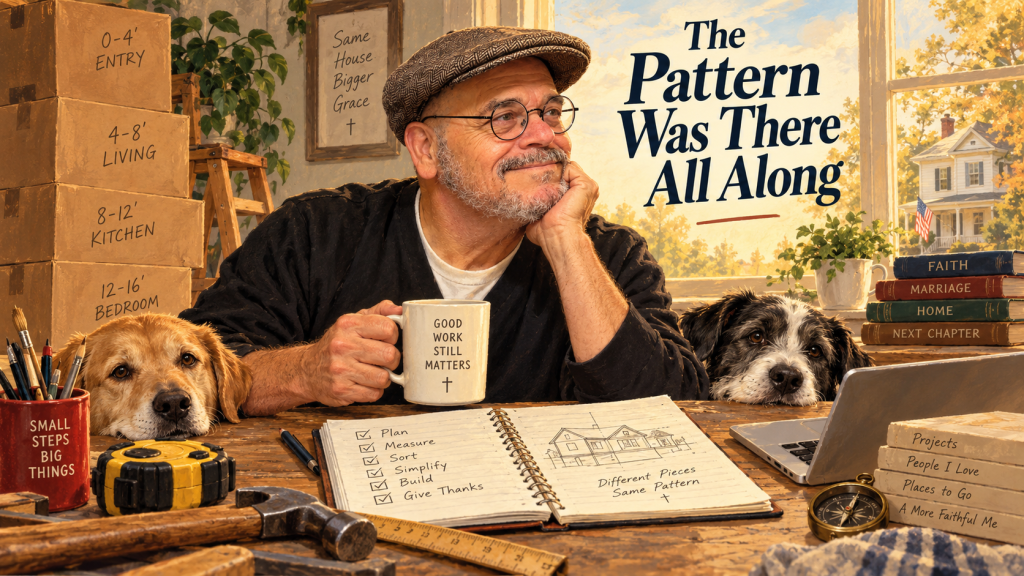
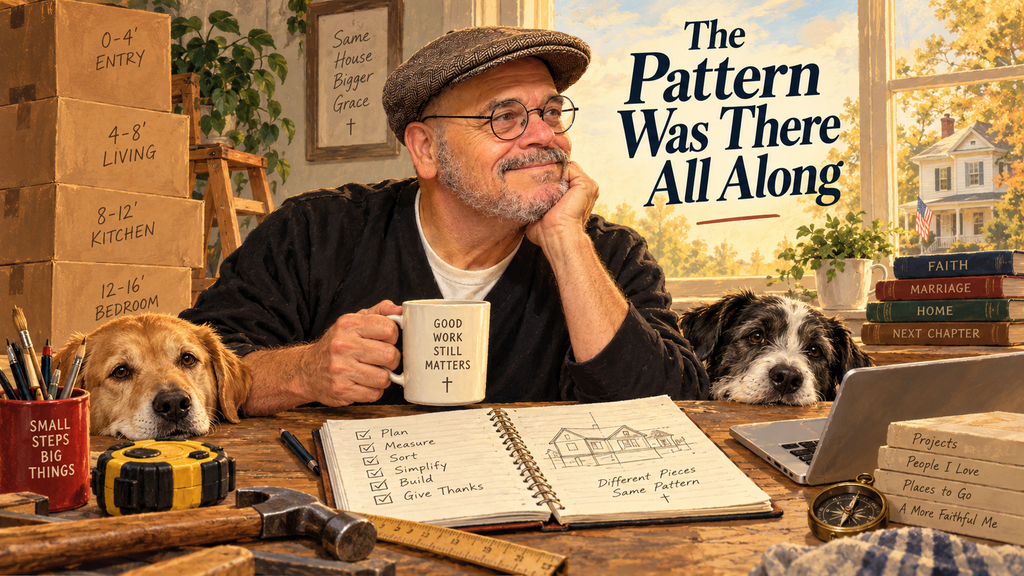
This morning started with a list.
Security cameras needed to go up. The locks in the garage needed to be changed. The filters on the washing machine needed attention again. Boxes from the move were still sitting around waiting to become part of the house instead of evidence that we had recently invaded it.
Then I remembered the computer.
That one bothered me more than the others. I still had not set it up. I had not gotten back to writing. I am preparing for an October Bible class, somehow managed to create a whole series of children’s teaching coloring pages for church, and I have a photorealistic portrait of our minister that I would like to have completed by Christmas.
And, just for entertainment, I still have a job.
Then there are the dogs.
Bun Bun, our little Yorkie, needs more attention now because her longtime playmate passed away. Salty Dog has discovered leash walking and has apparently determined that twice a day is now written into her contract. Bluey, who was discarded from a car and came to us weak, is becoming a strong, muscular dog who is also learning that walking on a leash does not mean dragging the old man around the acreage like a sled.
At some point I wondered when retirement was supposed to begin.
Then I realized retirement may simply mean having more hours available for things that will immediately fill those hours.
The house itself looked overwhelming. Stuff everywhere. Boxes, tools, things waiting to be fixed, things waiting to be put away.
The night before, I had read a blog written by a woman who cleans hoarder houses. Her philosophy was simple: do four feet at a time.
Do not clean the room.
Do not clean the house.
Clean four feet.
Clear that area completely. Put things where they belong. Clean the surface. Finish it. Then move to the next four feet.
I tried it in the kitchen.
Sixteen or eighteen minutes later, I had four feet of completed space.
What surprised me was how much difference four feet made.
When we skim across the entire house, moving a little here and a little there, we may work for hours and still feel as though nothing has happened. The mess simply changes shape.
But four feet finished is visible.
Visible progress changes something inside us.
We see completion.
Completion gives us enough satisfaction to move to the next four feet.
And there it was.
A pattern.
I seem to find patterns whether I am looking for them or not.
That led me back to art.
I am an artist, yet I use AI-derived images on Braxton’s Workbench. People occasionally give me some guff about that. Years ago, I probably would have agreed with them.
When Photoshop and digital art began becoming common, many of us thought traditional art was finished. We had spent years learning the compulsories: anatomy, perspective, value, composition, color theory, drawing, painting, all those foundational skills that took endless hours and sometimes endless frustration.
Then along came software that allowed someone to accomplish in minutes what had taken us years to learn.
It felt like cheating.
We also loved the physical experience of art. The smell of paint. The feel of graphite pulling across paper. Mixing pigments. The resistance of the surface.
Those things mattered.
They still matter.
But I eventually changed my mind.
I knew an artist who developed a severe autoimmune condition. Traditional materials became dangerous for him. Paint and even graphite could cause terrible skin reactions.
Digital art gave him a way to continue creating.
The tool changed.
The art did not disappear.
Years ago, I wrote in a paper for one of my professors that the finished artwork is almost the leftover of the artistic process.
The canvas is residue.
The paper is residue.
The true art happened before that.
It happened in the thinking.
The choosing.
The rejecting.
The wondering.
The mental labor required to discover what the artist was trying to say.
Writing works much the same way for me.
I often begin with fragments. A memory. A sentence. An old word. Theology. Medicine. Humor. History. Something I noticed twenty years ago. Something that irritated me yesterday.
At first, they may seem unrelated.
Then the pieces begin finding one another.
A pattern develops.
Sometimes my brain appears to know what I am writing before my conscious mind does. The act of writing itself brings the structure into view.
That took me back even farther.
When I was leaving the art world and moving deeper into medicine, some of my professors asked how I could reconcile those two things.
Art and medicine seemed completely different to them.
They were never different to me.
In art, we collect ingredients.
Shape.
Line.
Value.
Color.
Composition.
Emotion.
We use what we know. We use experience. We use something we casually call feeling.
Then we step back.
Did I miss something?
Does this belong here?
Is the thing I thought was important actually distracting from the whole?
Medicine works the same way.
We collect symptoms, pressures, laboratory values, imaging, physiology, history.
All the pieces may point toward one answer.
And that answer may be wrong.
So we step back.
We take the thirty-thousand-foot view.
What pattern is actually forming?
Then we move back in toward the details.
I failed Algebra I twice in college.
Factor trees made me want to rebel against civilization.
Yet during that same period I was working in cardiac trauma and diagnostic cath lab. I was the numbers guy. I calculated flow. I worked with gradients and pressures. I calculated valve information. I could work with square roots when those numbers meant something.
On paper, mathematics felt authoritarian.
Do this because the book says to do it.
In the cath lab, numbers told a story.
There was purpose.
That may be the difference.
Some of us learn rule first and application later.
Others need the application before the rule makes sense.
Give me a formula by itself and I may resist it.
Show me what that formula allows me to see, and I become interested.
The same pattern appears everywhere.
The art of medicine.
The art of building.
The art of teaching.
The art of animal husbandry.
The art of raising children.
The art of writing.
The art of living with another human being for decades.
We learn rules and materials, but eventually judgment matters.
Knowledge gives us pieces.
Experience teaches us which pieces often fit.
Wisdom asks whether we are looking at the right puzzle.
Even politics fits the pattern.
Most ordinary people are not waking up wanting to destroy the country.
They may disagree passionately about how to solve problems.
One buys building materials at Lowe’s.
Another goes to Home Depot.
Someone else prefers blue. Someone prefers red. Someone prefers purple or green or orange.
I like gray.
The real question should be: what are we trying to build?
Disagreement over materials does not necessarily mean disagreement over the house.
But when disagreement becomes identity, we stop judging the material and start attacking the carpenter.
Again, the answer may be to step back far enough to see the whole structure.
That same lesson showed up in smaller ways today.
I used to hate mandatory training modules at work.
I dreaded them.
I resented them.
I saw them as administration trying to control us.
Then something shifted.
Just do the module.
Dreading it takes energy.
Hating it takes more.
Defying it takes even more.
Resentment leaves little dents in the soul because we practice resentment until it becomes part of our reflex.
Administration is not necessarily the enemy.
They have boxes they must check too.
Accreditation.
Funding.
Regulation.
Documentation.
It is part of the beast.
Sometimes the quickest way to tame the beast is simply to check the box and move on.
This morning the house gave me two more lessons.
I went to repair the hinge on the garage door before changing the lock.
The wood in the frame is rotting.
That job is no longer mine.
Then I went to work on the washer filters.
The filters were not leaking.
The old brass faucets were.
They are connected to PVC in a way I do not feel confident repairing.
That job is not mine either.
The old version of me might have felt defeated.
Instead, I diagnosed the problem and delegated it.
That is not failure.
That is knowing which mountain is yours to climb.
I have a habit of climbing mountains.
Sometimes someone points and says, “Go climb that mountain,” and I race to the top, look three peaks over, and discover the flag was over there.
I climbed the wrong mountain.
Maybe that is why “Climb Every Mountain” makes me laugh now.
Sometimes I really do try to climb every one of them.
Eventually you get tired.
Persistence is good.
Choosing the right mountain is better.
Even the language we use follows this same pattern.
I have been trying to clean up the way I speak because Christian values are not something I want to perform only in public.
Private behavior is rehearsal.
Practice something long enough when nobody is watching and eventually it becomes what you do when people are watching.
So I discovered syllables.
Sometimes frustration needs force.
“Jiminy Christmas” carries considerably more torque than “gosh.”
“Dadgummit” has enough weight to get the irritation out without using words I do not want becoming part of my habits again.
It sounds silly.
It is not.
If we remove an old behavior without building a replacement, the empty space often invites the old thing back.
Everyone is someone’s child.
That is something I have taught staff for years.
Treat people the way their mama would want them treated.
Patient.
Coworker.
Housekeeper.
Administrator.
Student.
Everyone.
Standards still matter.
Correction still matters.
But dignity matters too.
And then there was perhaps the smallest experiment of all.
My wife and I have been married since dirt was new.
Not quite, but close enough to qualify.
Over the years, like most couples, we changed.
We have a king-size bed.
She had her side.
I had mine.
Between us was a sizeable piece of real estate.
So I removed it.
The king bed went to the guest room.
We put a full-size bed in our room.
Within a couple of weeks, something changed.
Not sexual intimacy.
Something quieter.
A hand resting against a shoulder.
A kiss on the cheek in the morning.
Waking up aware of the other person.
Talking differently.
Touch becoming accidental again.
The relationship did not need a grand repair.
The architecture needed changing.
That may be what this whole morning has been about.
Patterns.
Tools.
Architecture.
Four feet at a time.
A paintbrush is a tool.
AI-generated imagery is a tool.
Coffee can be a tool.
Mathematics is a tool.
A training module may be a tool.
A smaller bed can even become a tool.
The important question is not whether a tool is old or new.
The question is what we are building with it.
Maybe life itself works like composition.
We throw down pieces.
Work.
Marriage.
Faith.
Dogs.
Art.
Medicine.
Church.
Boxes.
Broken faucets.
Old words that probably should have been left peacefully buried in the eighteenth century.
At first, the whole thing looks scattered.
Then we step back.
And if we are patient enough, a pattern begins to appear.
Maybe the pattern was there before we noticed it.
Maybe the work is simply learning how to see it.