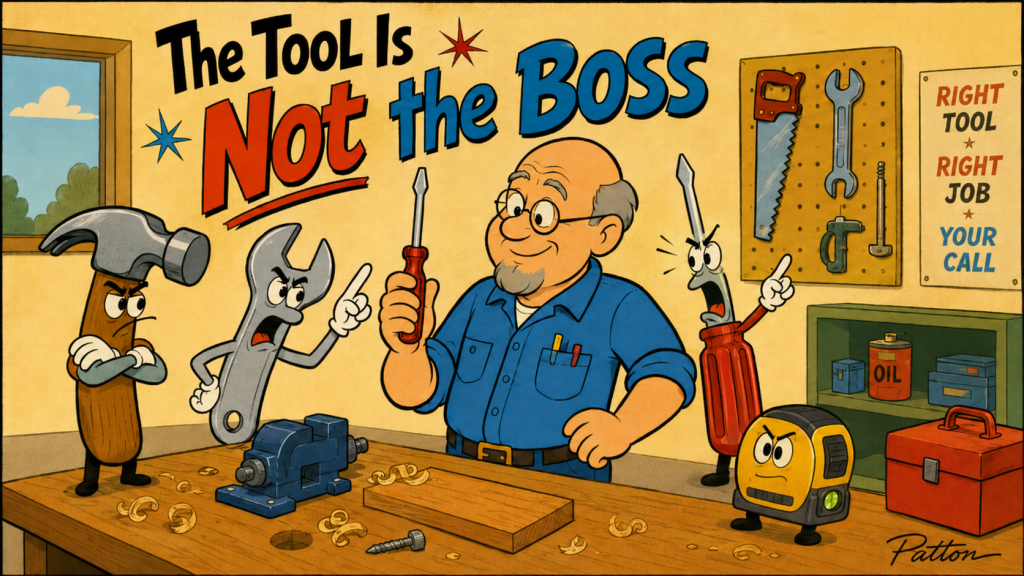
I have talked to a hammer before, and usually after I smashed a thumb. I have said a few unkind words to a socket wrench too, especially after dropping a starter on my face. That wrench did not warn me. It did not apologize. It did not offer comfort, guidance, or a liability statement.
It just sat there.
That is the thing about tools. They can help you build something, fix something, tighten something, or knock the hide off your knuckles. Folks, they do not carry the whole moral weight by themselves.
The hand using the tool matters. This is true in the garage, kitchen, art, and writing. And yes, that is true with artificial intelligence.
I use AI tools.
There it is, plain on the table.
Some of the illustrations you see on Braxton’s Workbench are created with the help of AI. I guide the look, the tone, the setting, the message, and the direction. I edit. I reject. I try again. I shape the image until it matches the piece as closely as I can get it.
I am not hiding that.
I also use AI as a sounding board at times. A place to throw a loose thought against the wall and see if there is something usable inside it. Sometimes a random idea is just a random idea. Other times, once it is held still long enough, it becomes an article, a lesson, a line, or a question worth asking.
AI also saves my wife a few interruptions.
For years, I have run sentences, lines, and half-formed thoughts by her until she was ready to hand me a red pen and a warning label. Around the Workbench, she may need her own character name: GrammarLeigh.
She is still my wife. She is still one of the people who knows when something sounds like me and when something sounds like I swallowed a pamphlet. But AI gives me a place to test the small stuff before I drag every comma into the living room.
That is not replacing a person; that is sparing one. She may even call it mercy and give me a wink.
That does not make AI the writer. The sentences are mine, the scratch paper scribbles are mine, the spiral notebooks filled with notes and the typing are mine. The stories are mine, the life behind them is my lived testimony, and the scars, the faith, and the responsibility are mine.
AI is not replacing my voice. I use it the way I use a workbench. It helps hold the thought still long enough for me to shape it. It does this by helping me with the outline to protect flow. The words, and yes, the spelling mistakes are mine. I still get sighs and frustration from GrammarLeigh; that’s just our marriage.
That distinction matters.
I am not new to art. I am an artist. I have been a cartoonist and illustrator. I have done the work when the work meant paper, ink, discipline, and patience.
I remember drawing gothic-style letters with pen and ink. And yes, it was drawing. You did not just write those letters. You built them. Each letter had weight, angle, spacing, rhythm, and mood. Before it went on the final paper, there was a test page. I would draw the same letter over and over until my hand understood it. Then I placed it on the page and started the whole process again with the next letter.
That kind of work teaches respect for the line.
I remember hand lettering. I remember silk screen work. I remember smoothing paint with turkey feathers. Good grief, some of that process was labor intensive. It was slow. It was messy. It took patience, setup, cleanup, and a willingness to do the same thing again until it was right.
Then tools changed.
When I was around art school and digital tools were becoming more common, Adobe Illustrator and Photoshop made a lot of traditional artists uneasy. Some folks looked at those programs and thought, “Now people can skip the hard parts.” There was concern that software would cheapen the craft. There was concern that people who could not draw would get attention because they knew how to use the computer.
Some of that concern was fair, and some of it was fear.
Those tools did not go away. Artists adapted. Some used them well. Some used them poorly. Some used them honestly. Some probably hid behind them. That is not new. Art has always had arguments over process, tools, shortcuts, and what counts.
I have seen people make art in ways I did not personally respect. I have seen work praised that had very little to do with traditional drawing skill, or what I call compensatory skill. I did not always like the process, but it taught me something.
The argument over tools and methods is not new. Artists have always disagreed about what matters.
Is it the hand?
Is it the idea?
Is it the process?
Is it the final image?
Is it the honesty behind it?
I still believe the hand matters. I believe skill matters. I believe learning to draw matters. I believe an artist should know line, shape, composition, light, expression, and story.
But I also know that tools have always changed.
A paper sketchbook is a tool.
A brush is a tool.
A turkey feather dragging paint across a silk screen is a tool.
A tablet is a tool.
Layers are tools.
Undo buttons are tools.
Texture brushes are tools.
Photoshop is a tool.
Illustrator is a tool.
And yes, folks, AI is a tool.
They are not all the same tool. They do not all require the same amount of hand work. I am not pretending they are identical.
But they are all still tools.
The question is not simply whether a tool was used. The question is what the human brought to it.
Did the human bring judgment, taste, honesty, responsibility, and stand behind the result?
That is where the weight lands.
A fork is a tool too. I can use it to feed my body, or I can use it to keep digging a hole, and hopefully not fall into it. Greens, beans, quinoa, yogurt, and nutritional yeast are tools in my rebuild. So are walking, chair exercise, and a blood pressure cuff. The refrigerator thermometer sitting there at 39 degrees, minding its business like a tiny food safety sheriff, is a tool.
But tools can be misused.
A person can stand in front of an open refrigerator and eat cold packaged wieners while deciding what to eat. I know that because I have lived in the same world as everybody else. That is not a planned meal. That is hunger, habit, and poor judgment holding a meeting while the open refrigerator door tries to cool the neighborhood. That’s what my mom would say about it.
A person can use food to rebuild or punish themselves. The food did not make that choice alone.
AI is similar.
Used with purpose, it can help organize a thought, clarify a sentence, create an image, check a blind spot, or turn a pile of mental bolts into something useful.
Used poorly, it can feed anxiety. It can become a loop. A person can keep asking it what might go wrong, then ask for reassurance, then question the reassurance, then dig deeper into fear. At that point, the tool is no longer helping the person return to life. It is helping fear build a room and hang curtains.
That does not mean the tool is evil. It means calibration matters.
Y’all, the tool becomes what you feed it.
If I feed it honest reflection, clear questions, real experience, and responsibility, I may get something useful back. If I feed it panic, avoidance, vanity, or laziness, I should not be shocked if the result smells like panic, avoidance, vanity, or laziness.
This is where the human condition walks in wearing muddy boots. I tend to speak of muddy boots a lot. Here in East Texas, certain times of the year, your boots are always muddy.
People are people. We can turn almost anything into either help or harm. We can use a hammer to build a porch or smash a window. We can use a skillet to cook a meal or burn supper until the smoke alarm drives us crazy. We can use a fork to rebuild health or keep doing damage. We can use AI to organize thought or avoid thinking.
The tool is not the boss.
That does not mean we should be careless. A talking tool needs more discernment than a silent one. A socket wrench never answered me back. AI does. That can make it feel more alive than it is. But response is not the same as life. The ability to use language is not the same as wisdom. Just ask your co-worker. Usefulness is not the same as authority.
AI has no soul, no childhood wounds, no hunger, no pride, no prayer life, no family table, no cancer checkup on the calendar, no sore thumb from a hammer, and no starter falling on its face.
It is a tool with a voice.
That means the person using it has to stay awake.
For Braxton’s Workbench, my rule is simple: keep the tool on the bench, not on the throne.
I will not pretend I do not use AI. That would be dishonest.
I will also not pretend AI is responsible for writing what I publish. That would be cowardly.
If my name is on it, then I own it.
The illustrations may be AI-assisted. The writing may be shaped with the help of a digital sounding board. But the direction, the judgment, the lived experience, and the responsibility belong to me.
That is how I see it.
Wrenches, sockets, greens, quinoa, forks, skillets, notebooks, keyboards, tablets, ink pens, brushes, software, and AI are all tools. Some build. Some feed. Some draw. Some help sort thoughts. Some can hurt if handled carelessly.
None of them should replace judgment, conscience, or a real human life, and none of them is the boss.
The hand holding it matters.