
The Hilarious Joy of Language: Dangling Participles, Misplaced Modifiers, and Neobombeckianism

I have recently developed an interest in grammar.
There. I said it.
At my age, I suppose there are worse things a fellow could become interested in. I could start collecting porcelain frogs, arguing with the television, or wearing socks with sandals. Instead, I have taken up the study of dangling participles, subordinate clauses, and other things that sound as though they should not be discussed in polite company.
I never intended to become a grammarian. I simply wanted to become a better writer.
Apparently, there is a difference, although I suspect the two professions meet occasionally in dark hallways to exchange punctuation marks.
It started innocently enough. I wanted to understand why certain sentences worked and others did not. I began asking questions about commas, sentence structure, and the occasional misplaced modifier. Before long, I discovered that the English language has more rules than a homeowners association, and nearly as many opportunities for disagreement.
Consider the dangling participle.
The first time I heard that expression, I pictured some poor fellow hanging from a tree branch by the seat of his trousers.
As it turns out, a dangling participle is a grammatical modifier that has lost track of what it is supposed to be describing.
For example:
Walking down the road, the barn came into view.
Now, unless the barn has developed legs, someone has neglected to identify who was walking.
This is apparently a serious matter among grammarians.
I have also discovered that a misplaced modifier can change the meaning of an entire sentence. A misplaced comma can cause confusion, and an ambiguous pronoun can create a family dispute.
Take the old children’s song:
There was a farmer who had a dog, and Bingo was his name.
Whose name?
The farmer’s or the dog’s?
Generations of children have been singing this song without demanding clarification. Entire classrooms have clapped their hands and shouted B-I-N-G-O without once establishing the identity of the individual involved.
I find this troubling.
Then there are subordinate clauses. I had assumed these were clauses that worked under the supervision of more experienced clauses, perhaps receiving a modest salary and limited vacation time.
No. They are simply groups of words that cannot stand alone as complete sentences.
I can sympathize. There have been mornings when I could not stand alone without coffee.
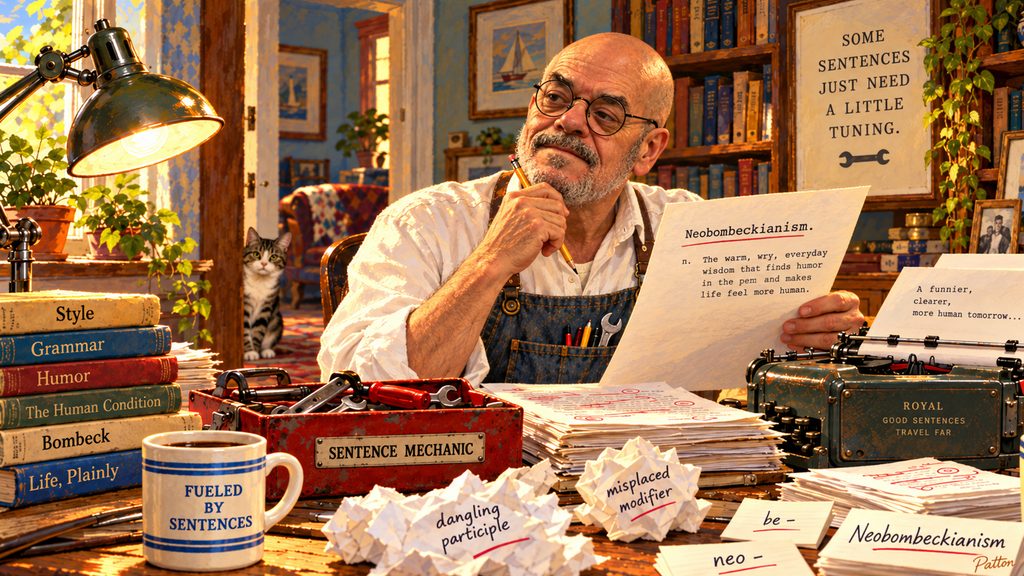
Somewhere in all this grammatical exploration, I became what I now call a sentence mechanic.
I approach a paragraph with a flashlight, a handful of punctuation marks, and a suspicious attitude.
I look beneath the hood.
I check the timing.
I listen for unusual noises.
Occasionally, I discover that a sentence has been operating for three paragraphs without a functioning verb.
That would explain the knocking.
My wife, Christina, has become involved in this adventure. She is The Grammarian.
I should explain that this title was acquired entirely through her own free will. Nobody appointed her. There was no election, no official ceremony, and certainly no salary negotiations.
She simply began correcting things.
Once a person voluntarily assumes such a position, I believe there are obligations. You cannot spend years pointing out grammatical offenses and then complain when your husband comes home excited about prefixes.
Which brings us to this morning.
I discovered that the prefix be- can help form verbs from nouns and adjectives. A person can befriend someone, bewitch an audience, or bedeck a room.
Naturally, I began experimenting.
Could something be besonged? Could a perfectly respectable theatrical production be besonged beyond all recognition?
Possibly, if the writer supplied enough context and absolutely refused to apologize.
Then came neo-, meaning new.
Neoclassical. Neologism. Neoform.
A neologism, I learned, is a newly created word or expression.
By this point, I was practically vibrating with linguistic enthusiasm.
Then it happened.
Neobombeckianism.
A new literary movement devoted to finding humor in ordinary life, domestic disorder, aging, troublesome animals, and the stubborn conviction that humanity might benefit from laughing at itself occasionally.
I immediately recognized the significance of my discovery.
Christina did not.
I carefully explained the linguistic principles involved. I discussed prefixes, word formation, and the remarkable flexibility of American English.
She listened with an expression suggesting that the refrigerator needed cleaning.
This was disappointing.
Here I was, standing at the threshold of a possible literary revolution, and the Chief Grammarian appeared unwilling to acknowledge the historical importance of the occasion.
Nevertheless, scholarship must continue.
I have since prepared an official statement announcing the emergence of Neobombeckianism as a legitimate literary neoform.
Peer review will not be accepted at this time.
I expect the announcement to receive approximately the same response as my previous linguistic observations on Facebook.
Crickets.
But silence is not necessarily rejection. I prefer to believe readers carefully consider these scholarly declarations before quietly placing their phones on the table and walking into another room.
Perhaps they need time to reflect.
Perhaps they are frightened.
Perhaps they have simply decided that I should spend more time outdoors.
Whatever the explanation, I shall continue my studies.
Because beneath all this nonsense, something rather wonderful has happened.
I am discovering the joy of language itself.
Words are not merely containers for thoughts. They have texture, rhythm, personality, and occasionally a loose screw. Moving one word can change the pace of a sentence. Replacing another can transform an ordinary observation into something worth remembering.
Grammar gives us the tools to understand why.
And humor reminds us not to become insufferable while using them.
I have no desire to become the sort of writer who measures every sentence with a ruler and issues citations for unauthorized adjectives. I want to know the rules well enough to recognize when breaking one serves the story.
Sometimes a fragment works.
Sometimes a sentence needs room to wander.
And sometimes the most important thing a writer can do is put down the grammar book, look out the window, and notice that the cat has once again refused to cross the threshold.
That is life.
That is language.
And somewhere between the two sits an old fellow at his workbench, tightening a sentence with a borrowed wrench while his wife wonders what on earth he has gotten into now.
I believe I shall call it progress.
The Grammarian may disagree.
Her objections, however, must be submitted in writing, with proper punctuation.