The Evolution of a Writer: Discovering That Writing Is No Longer a Test, But a Way of Seeing

When I first started writing in earnest, and yes, I do understand the importance of being earnest, much of it came from emotion.
Sometimes entirely too much emotion.
A memory would open and there it was.
Not a gentle knock.
More like somebody had popped the clutch.
The engine would roar, the tires would grab, and suddenly I was three decades backward wondering who gave memory the keys.
There were tears I did not particularly want anyone to see.
There were moments when I wondered whether writing was worth stirring up things I had spent years carefully putting in boxes marked:
DO NOT OPEN UNLESS ABSOLUTELY NECESSARY.
Naturally, writing opened them anyway.
At first, I think I was trying to prove something.
Maybe to myself.
Maybe to other people.
Maybe to some invisible panel of judges who, as far as I know, were never actually appointed.
Could I write?
Did I have anything worth saying?
Could I take the things in my head and make them behave long enough to stand upright on a page?
That was part of it.
There was something determined about those early pieces.
Not angry exactly.
But they did occasionally arrive wearing work boots.
I had something to say and, by golly, I was going to get it said.
Then something changed.
The emotion did not disappear.
It simply stopped kicking the door in.
It became more of a purr.
Familiar.
Present.
Still capable of showing itself, but no longer arriving with sirens.
No more popping the clutch every time a memory appeared.
Which is probably fortunate because I recently realized half the population may no longer know what popping the clutch means.
Even our 1976 Pinto had a clutch.
Her name was Betty.
The car was named Betty before my brother-in-law married a woman named Betty, and I feel that historical distinction should be preserved before someone accuses me of something.
The Pinto had seniority.
Cars had personalities then.
They argued.
They sulked.
They occasionally refused to cooperate.
We named them because you had relationships with them.
Modern cars are probably offended by this, but they can take it up with the Grammarian.
She has recently expanded her jurisdiction.
The Grammarian, for those unfamiliar with my household government, is my wife.
She has informed me that perhaps I should put everything before her before posting or sending it.
Apparently she would like to earn her keep.
I find this particularly concerning because she recently caught a spelling issue after I had already stared at a piece long enough to qualify for residency.
Writers do this.
You read what you meant to type instead of what is actually sitting there waving at you.
But somewhere in all of this, writing changed.
It stopped being only about emotion.
I began noticing words.
Not just what they meant.
How they sounded.
How they leaned against one another.
How one word could carry more weight than another.
How people wrote two hundred years ago.
How a sentence could wander halfway across the countryside and still somehow return home before supper.
I started noticing rhythm.
Cadence.
Silence.
Even punctuation started developing personality.
That is probably a warning sign.
I began enjoying old words.
Old sentence structures.
Old books.
This has become serious enough that I have even considered rereading Wuthering Heights.
I know.
Let that settle for a moment.
As a hormone-driven youth, I considered that book a literary endurance test.
There seemed to be fog, misery, bad decisions, more fog, and several people who desperately needed to stop speaking to one another.
Now?
I may appreciate it.
I said may.
Let us not get reckless.
Something else changed too.
For years, music was tied tightly to memory.
A song would bring back a place.
A lyric would open a door.
Laura Branigan could start singing Gloria and suddenly an entire decade would show up wearing questionable clothing.
Sometimes all it took was a few notes and there I was.
But lately, memory has not been arriving as music.
It has been arriving as sound.
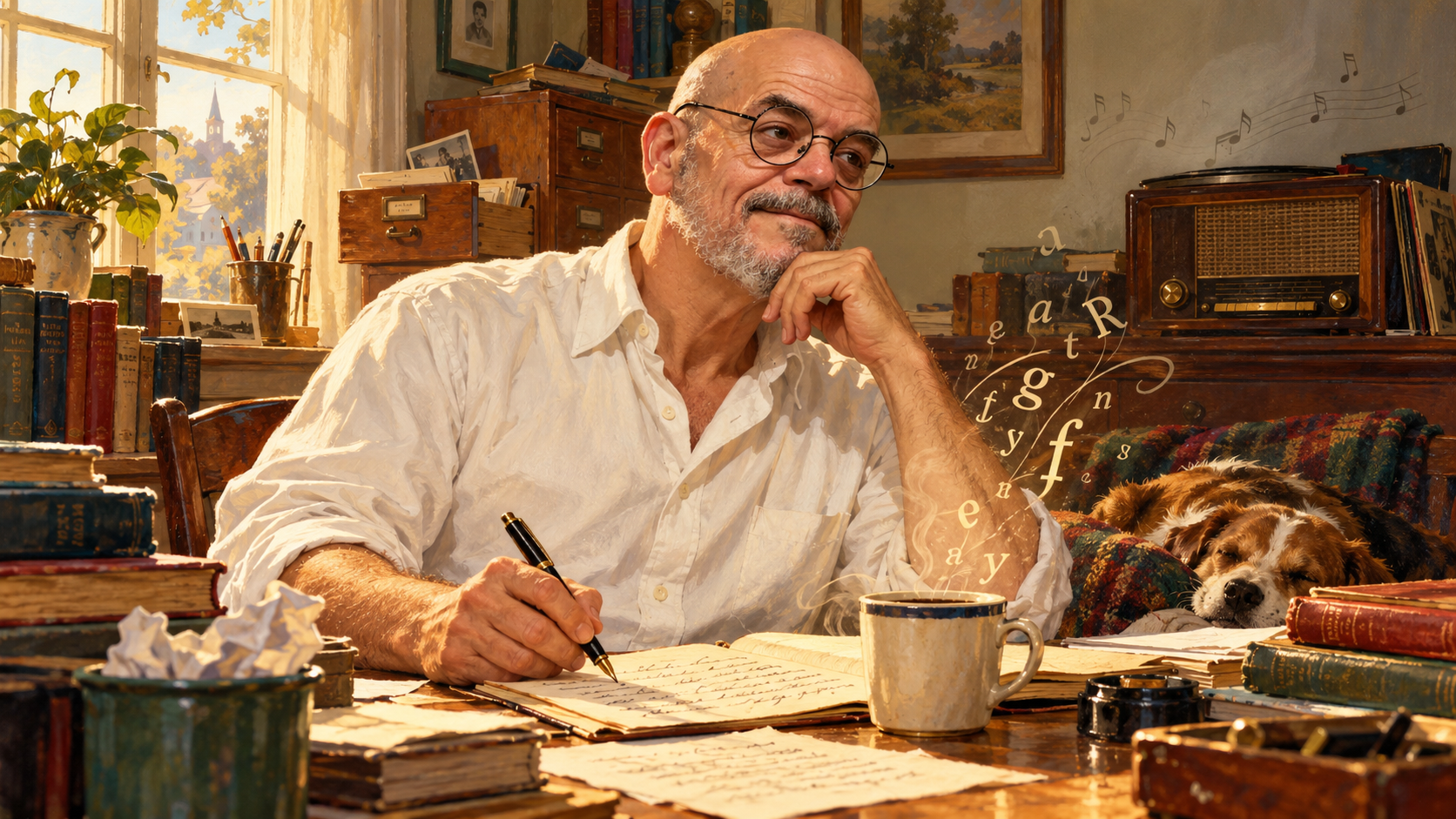
The creak of a metal file cabinet.
The dry slide of an old wooden dresser drawer.
A chair shifting across a floor.
The click of something mechanical.
The hush of a room.
The little sounds people do not think to remember.
The world has become more textured.
Less soundtrack.
More atmosphere.
Words sometimes arrive the same way.
Not like a trumpet.
Not like a march.
More like a brook coming to a small fall in the rocks.
The water was already moving.
Then suddenly the ground changes and the sound becomes different.
That is how the words feel now.
They come.
I do not always know where they come from.
At this point I have stopped asking too many questions.
The last thing I need is for the answer to involve another rabbit hole.
Although, to be fair, rabbit holes have become fairly productive.
One minute I am thinking about a Pinto named Betty.
Then Betty reminds me of my brother-in-law.
Brother-in-law becomes brother.
Brother becomes Brother in Christ.
Suddenly the word brother has opened six doors and I am standing there wondering when the clutch popped.
That is apparently how my brain works now.
I suspect telling my physician this would be unwise.
He might start asking questions.
I would rather not have to explain that no, I am not necessarily distracted, I am simply following a word down a hallway to see where it lives.
Even the way I communicate with family has changed.
I am more aware of how something is said.
What it means.
What it might imply.
What is left unsaid.
Sometimes there is a little something hidden in the wording and the receiver may or may not notice.
That part is enjoyable.
It is almost linguistic hide-and-seek.
Someone who knew me years ago noticed the change.
That matters.
She was one of the people who taught me precision in another life, back in the cath lab days.
She was not gentle about it either.
I was the little brother.
Mercy was apparently considered poor educational technique.
Back then the lesson was:
Watch the tracing.
Small changes matter.
Now the lesson is:
Watch the sentence.
Small changes matter.
Different monitor.
Same anxiety.
Funny how one world can train you for another.
I have lived in several worlds.
Youngest in one place.
Eldest in another.
Student.
Teacher.
Jokester.
Fixer.
Friend.
Brother.
Brother-in-law.
Brother in Christ.
That word alone has more depth than I realized.
Brother.
Same word.
Different kind of belonging.
That is what language has started doing for me.
Opening rooms.
I used to run from patterns.
Patterns meant predictability.
Predictability meant chaos could find me again.
So randomness felt safer.
I did not want life knowing where I lived.
But now I see pattern differently.
Pattern is life.
And when I look back, my pattern did predict something.
It predicted survival.
That surprised me.
For years, I thought pattern was the thing I had to escape.
Now I realize pattern was also the evidence I kept going.
Maybe writing helped me see that.
Or maybe writing simply slowed me down enough to notice it.
That may be the biggest change of all.
At first, writing was something I was doing.
Now it is becoming a way of seeing.
I notice words.
I notice sounds.
I notice old phrases.
I notice the weight of a pause.
I notice that a simple word such as brother can stop me in my tracks.
I notice that a misspelled word can make me think about my own behavior.
Which is irritating.
I preferred spelling errors when they stayed in their lane.
And somewhere along the way, writing stopped feeling like a test.
The courtroom emptied.
I no longer feel quite as compelled to prove that I belong at the desk.
The old imaginary art police have apparently lost my address.
Back in art school I used to half expect them to come through the door, confiscate my sketchbooks, point toward the exit, and say:
“Sir, step away from the easel.”
They never came.
I have begun to suspect they were understaffed.
The same thing happened with writing.
Nobody arrived to confiscate the keyboard.
Nobody demanded my thesaurus.
Nobody revoked my paragraph privileges.
So I kept going.
Reading.
Listening.
Revising.
Enjoying the craft.
That may be the word I was looking for all along.
Enjoyment.
Not escape alone.
Not therapy alone.
Not proof.
Not performance.
Enjoyment.
The simple pleasure of finding the right word.
The satisfaction of a sentence landing where it should.
The surprise of discovering meaning in a phrase I have used all my life.
The strange delight of realizing that punctuation can become interesting.
That last one may require professional observation.
The quiet thrill of language becoming something more than a vehicle.
It has become the road itself.
Maybe I thought I was learning how to write.
Perhaps what I was really learning was how to listen.
And now I am enjoying the sound.
Even when the Pinto backfires.
Maybe I thought I was learning how to write. Perhaps I was learning how to listen. Somewhere along the way, the road changed. So did I. And for once, I am in no hurry to reach the end of it.