One small brush with mortality can pull open the drawers of the mind and shove every hidden emotion into the room. So here we go.
Driving today, looking at the view rising ahead along the highway, I found my thoughts coming fast and furious.
No, I was not speeding, y’all.
Well, not that I am willing to admit, anyway.
Many of the highways we travel today have been traveled for a couple hundred years, perhaps longer. Some began as paths walked by Indigenous people following trails worn into the land by their forefathers. Before pavement, before road signs, before gas stations and glowing maps on a dashboard, there were feet, horses, wagons, and memory.
That thought brought back something my grandmother once told us about moving up the Caprock to Lubbock, Texas.
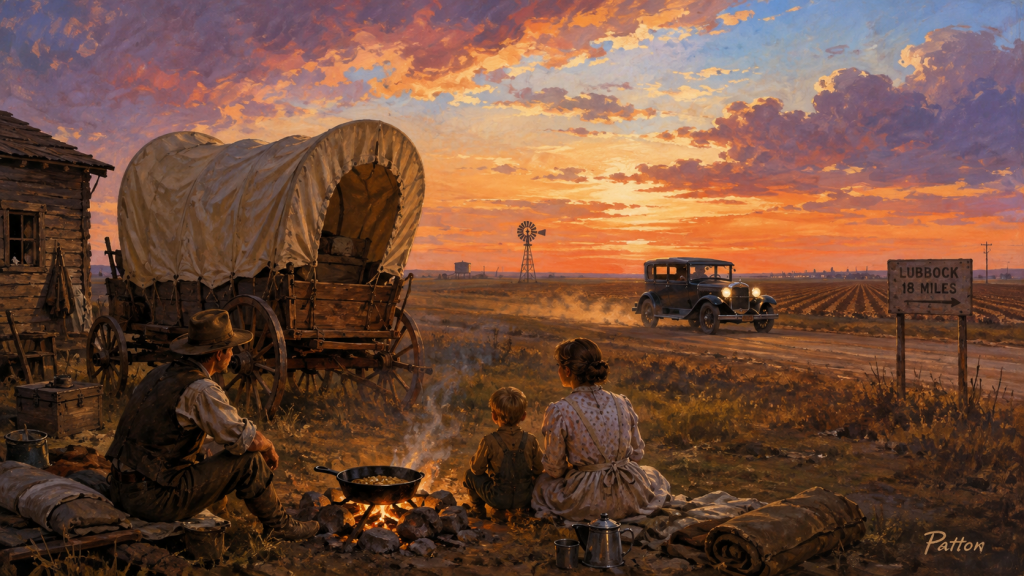
When you first hear the story, you imagine the 1800s. She spoke of the wind, the rain, and the heat leaking through the cover of their wagon. Her family traveled by covered wagon, using both horses and mules.
What a different world that must have been.
Then I stopped.
We had recently celebrated her fifty-seventh birthday, and as folks say these days, the math did not math.
This was not some dusty tale carried forward from the 1800s.
It happened in 1931.
She was eleven years old.
When we picture the 1920s and early 1930s, we often see New York City. We imagine crowded streets, electric lights, automobiles, jazz, flappers, and people rushing through a modern world.
But another world existed at the very same time.
Far from the city lights, families were still crossing the plains in covered wagons. Horses and mules pulled them through wind, rain, dust, and heat. One world was racing toward the future while another was still traveling roads that had changed very little in generations.
Two worlds, existing at once.
The same country.
The same year.
Perhaps even the same road we travel now.
That is enough to make a person slow down, look up at the sky, and wonder how time can feel so distant when it was never very far away at all.
I remember, in my youth, driving through the Texas Panhandle and coming across the small town of Vega, not too far from Tulia or Happy, Texas.
Yes, Mrs. Stewart, I remember Happy too.
The roads were paved, but they seemed to stretch for miles in either direction, with rarely another soul in sight. The plains opened wide around you, and the sky felt large enough to swallow every thought you had brought with you.
I also remember driving through Kaufman County and accidentally discovering the town of Frog. I might never have known it existed if not for the sign beside the road. There was no grand entrance, no busy downtown, no reason for anyone to stop unless they already knew someone there.
Yet these small Texas towns were rich with life and history.
People lived there. They married, worked, raised children, and, if they were fortunate, helped raise their grandchildren too. The local church, post office, or family market likely became the center of everything. News traveled there. Concerns were shared there. Stories grew longer there.
And I am certain there was more than a little ratchet-jawing from folks leaning against their cars, solving the problems of the county while nobody was in any particular hurry to leave.
Now let us get back to Lubbock.
The town could be seen in the distance beyond rows of freshly plowed fields. That sight still makes my heart ache from time to time. The land was so flat you could almost see time coming.
But I digress.
Yes, it is difficult for me to hold on to a single thought when all those memory doors start opening at once.
Grandma and her family were moving to Lubbock in a covered wagon. Before they ever began the trip, they had already arranged to rent a homestead through the mail.
Can you imagine the waiting?
They mailed off their request and then had to trust that, somewhere far away, somebody would receive it, read it, make a decision, and eventually send an answer back. I am sure they did not call it an “application” in 1931, but whatever they called it, the process may have taken months. Perhaps even longer.
There was no website to refresh.
No confirmation email.
No little spinning circle telling them the page was loading.
They simply waited.
Folks today become irritated if the cash machine takes more than three seconds to hand over fifty dollars.
Grandma’s family may have spent months waiting to find out where they were going to live.
Yeah.
Two worlds, indeed.
The Maynard clan finally made it to Lubbock after traveling all the way from China Spring, Texas.
They rode part of the way and walked part of the way behind the wagon. Even writing that sentence pushes the imagination backward toward the 1800s.
But it was not the 1800s.
It was 1931.
Just thirty-one years later, I would be born.
Think about that for a moment. From where we stand today, thirty-one years ago would place us in 1995. That does not feel like ancient history. Many of us remember the music, the cars, the clothes, and the world as it was then.
Yet the same span of time separated my birth from my grandmother walking behind a covered wagon across Texas.
That gives the story a different weight.
The wagon was not from some unreachable pioneer age. Its wheels turned close enough to my own lifetime that the dust had hardly settled.
When the Maynard family arrived, they could not move into the house right away. Repairs still had to be made, so for several days they slept in the wagon and cooked their meals over an open campfire.
I can picture that old cast-iron skillet balanced on rocks above the flames, supper sizzling while the wind moved across the plains.
I am also fairly certain a rattlesnake or copperhead had already decided the old house would make a fine forever home. The family may not have been the first occupants, just the first ones expected to pay rent.
At least the well was in good condition.
With a well, all you needed was a long rope, a bucket, and the will to keep pulling.
Come to think of it, that was probably true of nearly everything in their lives.
These people were built hard and built tough, but I doubt they thought of themselves that way. They were not trying to become legends. They were simply doing what had to be done.
It was not pioneer courage to them.
It was just life on the plains of Texas.
Time came and went.
The children grew up, found the loves of their lives or, ahem, perhaps the love of the moment, and had children of their own. They built homes, raised families, and, without realizing it, became part of the next layer of history.
Slowly, time began catching up with them.
The Lubbock area grew and rapidly became “modern.” Roads improved. Houses appeared where open fields had once stretched toward the horizon. Electric lines, automobiles, stores, and neighborhoods changed the shape of the plains.
So many changes arrived within what now seems like only a few brief moments.
Then time passed through my mother’s generation. We were all born, for better or worse, and before long we offspring were growing up too.
We picked peas, chased horned toads, and tried to outrun bees and wasps. We wandered those fields without thinking much about how long they had been there or how quickly they might change.
Around the age of seventeen, I began to take notice of my surroundings.
I noticed the wide-open spaces and the wind that seemed never to cease.
Well, the wind did cease whenever you were picking peas, mending a roof, or mowing the yard. Then the air would become as still as a church congregation after the preacher asks for volunteers.
But that is another story.
I also began to notice what was missing.
The horned toads did not appear as often. The hognose snakes, once familiar visitors, began making only rare and brief appearances. Creatures I had assumed would always be there were quietly retreating from the landscape.
Things were changing.
Dust devils still danced across the open fields, twisting upward beneath that enormous sky. But the small towns began fading into the distance.
Some faded from the road.
Others faded from the map.
And, perhaps most quietly of all, they began fading from our memories.
I remember taking long walks while living in the country near Tulia, Texas.
There was a dusty road, probably built by a few farmers so they could reach the deeper fields away from the highway. The road seemed to belong to no one and everyone at once.
As I walked, I could hear the bass hum of the irrigation motors rolling across the fields.
It was not silence.
It was better than silence.
It was a near-silent hymn, acknowledging those who had come before us.
This would have been around 1977 or 1978. I walked that road with thoughts coming and going, sometimes speaking them aloud because there was no one nearby to hear me.
Or perhaps there was.
The land had heard plenty by then.
It had heard the creak of wagon wheels, the pull of harnesses, the shouts of farmers, the laughter of children, the prayers whispered over sickbeds, and the grief of families burying their own.
Walking there, I thought about the hardships, the joys, the sorrows, and the losses of people whose names I would never know.
And I remember saying aloud:
“I remember you.”
It was a strange thing for a boy to say to an empty road.
Good thing I was alone.
The tears came unwanted, but they came anyway.
Perhaps that road was not empty after all.
Where are we going?
I ask myself that question all the time.
Where is all of this going?
Even now, a slight smile comes to my face because, in the end, perhaps it does not matter as much as we think.
What matters is the road we traveled.
The work we did.
The memories we carried.
The family waiting for us at home, and the memory of those who came before us.
Right now, in this moment, I am not so far removed from the grandmother who traveled by covered wagon to Lubbock. Her world and mine did not exist in separate ages. They overlapped. We traveled some of the same roads, stood beneath the same sky, and felt the same Texas wind against our faces.
Tell your children the stories.
Do not forget the people who came before you and created a path for you to follow.
Remember the horned toad you tried to capture because you wanted to save it from itself. That was the mind of a child, full of wonder and entirely unconcerned with consequences.
Remember the dusty fields and the wide-open spaces.
Remember the sleepy little towns fading from the road and the map, towns that may disappear from memory within another generation.
Hold on to them.
Say their names.
Remember them, because they mattered.
They still matter today.
Perhaps that is where all of this has been going.
I believe I finally understand the meaning of life.
It is not the destination.
It is the living.
It is life.