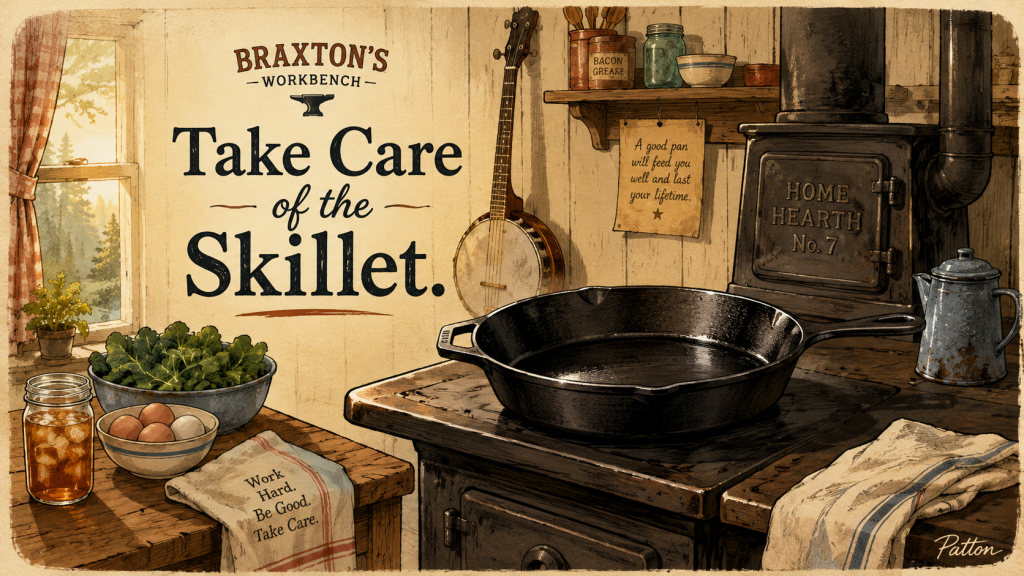
This morning I looked at my cast iron skillet and smiled.
That may sound like too much pleasure over a cooking skillet, but I know some of you understand. A well-kept cast iron skillet has a kind of quiet authority. It does not shine like stainless steel. It does not need a digital display. It does not beep, chirp, update, or ask to connect to Wi-Fi.
It just sits there, dark and seasoned, ready to work.
Last evening I cleaned it, dried it, oiled it, and set it back where it belonged. This morning it looked almost proud of itself. Or maybe I was proud of it. Maybe both.
There is something deeply satisfying about taking care of a tool that has taken care of you. Cast iron is not delicate, but it should not be neglected. It can handle heat, but it still needs attention. It comes with a past and handed down from a previous generation. It can cook a mess of greens, fry eggs, warm beans, hold together leftovers, and turn whatever is in the refrigerator into something that resembles breakfast. It’s a breakfast that I call refrigerator hash.
That can sound simple, but simple things often carry more than we first notice.
Somewhere way down in the holler, I can hear a banjo playing. Not as a joke, or as comic relief. It is not some tired insult aimed at country folk. I hear it as remembrance, and I hear roots.
I hear the old path through Appalachia. I hear piney woods and porch boards. I hear people who knew how to make do, people who kept going because stopping was not an option. I hear my mother on the back porch when she thought no one was listening, sipping iced tea and yodeling, or singing some old song from her youth. Her accent was stronger then, and over the years it faded, and I understand why. A lot of us learned to hide the sound of where we came from.
Folks, that is a little sad.
The very thing we once tried to cover up, the thing we may have called shame, begins calling us home as twilight nears. No, not back to the pain, or back to poverty. Not back to fear, harm, or the parts of the past that never should have happened.
Home to the flavor, and home to the grit. Home to the old songs, the porch, the plain tools, the skillet, the family heart, and the stubborn will to keep living.
I come from more than one line of survival. There are many names and many branches in any family tree, but two speak to me with a strong voice. On my Daddy’s side, I think about Ulster Scots coming to the New World, bringing with them grit, faith, hard edges, and a willingness to face rough ground. On my Momma’s side I also think about Forny, who survived the slave ships and was bought in Florida. I will not pretend to tell stories that are not fully mine to tell. I will not turn suffering into decoration, but I can draw from the fortitude that reached me through them. Both lines had different histories, wounds, and traveled different roads.
They both remind me of something: life came forward anyway, and that matters to me.
When I say “pick up the fork,” I am not just talking about diet. I am talking about participation. I am talking about honoring the life that reached me through storm, sorrow, injustice, hard work, faith, and ordinary love.
Somewhere in the distance, I can almost hear Clyde singing “O Death” from his soul. That old sound does not make death into a cartoon villain. It does not pretend we are immune. It simply stands in the dark and asks death to wait another day.
That is closer to the heart of my rebuild than most people may realize, or even I realized.
I have had my own conversations with mortality. Heart surgery. Cancer. Chemo. Scans. A missing lung. Long halls. Quiet prayers. Family watching. Doctors talking in careful voices. Those moments strip the polish off a man.
You know when the polish comes off, you find out what is still there.
For me, one of the things still there was this old, plain, stubborn voice saying, get up, and use what you have. Remember to do the part that is yours. Now pick up the fork.
That fork was not picked up because I hated where I came from. I picked it up because I remembered where I came from.
That is why I can talk about cast iron with a straight face.
A skillet carries memory. It carries breakfast. It carries Sunday mornings, field hands, grandmothers, mothers, fathers, children, leftovers, lean times, better times, and the smell of something cooking when someone was hungry.
But memory does not get to drive the truck or pull the wagon forever.
That same skillet once knew biscuits and gravy pretty well. Let us not act like biscuits and gravy did something criminal. They did not. Biscuits and gravy are part of the table for a lot of us. They are comfort food, family food, cold morning food, workday food, and church breakfast kind of food. They have their place in memory.
But in my house, biscuits and gravy are currently on hiatus. Let me be clear biscuits and gravy are not hated, not banished, or mocked. Just on hiatus.
Because I had to tell the truth.
The truth is, my body changed. My mission changed. My health demanded attention. My blood sugar, weight, heart, lungs, and future all had a vote. I could not keep eating certain foods as if nothing had happened and then call that honoring my roots.
That would not be heritage, it would be stubbornness wearing its grandpa’s hat.
I still respect biscuits and gravy. I just do not give them regular keys to the house anymore, and that is not shame. That is stewardship.
The skillet stayed, some habits changed.
The roots remained.
That is important. Rebuilding does not require me to sneer at the old table. I do not need to insult the food that once fed people I love. I do not need to pretend I was raised by nutrition labels and filtered water. I came from gardens, skillets, jars, leftovers, hard work, old songs, strong accents, and people who did what they could with what they had.
Now, I also live in this body now. This body has been through war, and it is not a museum.
This body is where I still have to live, love, serve, walk into church holding my wife’s hand, laugh with grandchildren, write, work, breathe, and choose life.
So, I take care of the skillet, and I take care of this body.
I still remember the old songs and can hear the faded memory of the banjo down in the holler.
I do not confuse memory with permission to stop paying attention.
And I do not call shame what may have been strength all along.
The skillet is plain, but it is not lesser.
The accent was country, but it was not ignorance.
The food was simple, but it was not meaningless.
The people were worn, but they were not weak.
The past is complicated, but it was not empty.
So yeah, I cleaned and oiled the cast iron. I looked at it this morning and enjoyed the sight of a fine-tuned skillet ready for work. Maybe that is a small thing, but small things have held me together more than once.
A fork.
A skillet.
A porch song.
A hand held walking toward the church building.
A bowl of greens.
A prayer asking death to wait another day.
A choice made again this morning.
Take care of the skillet.
Take care of life still in your hands.