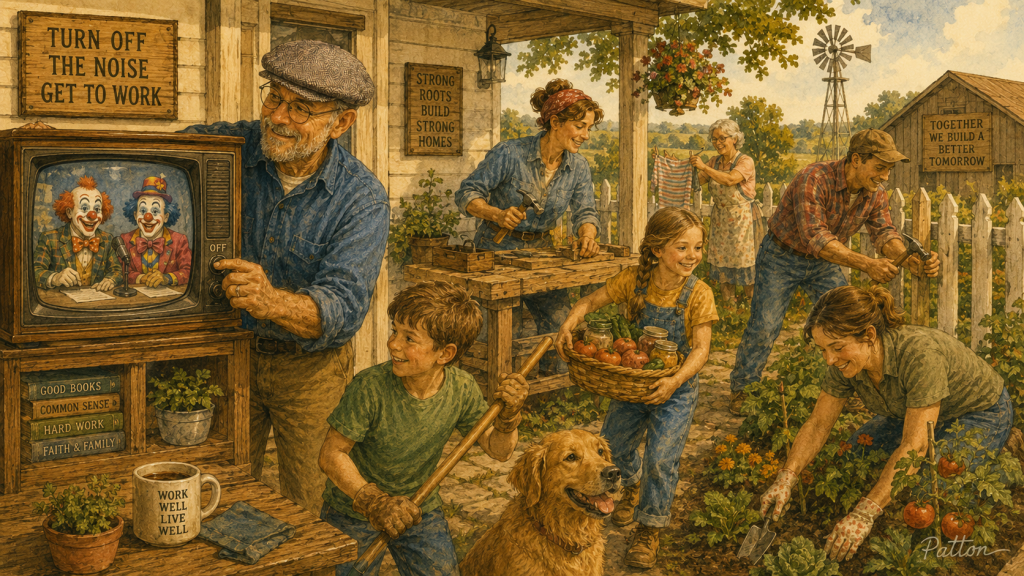
There are days when I look at what passes for news and wonder if the whole world needs to pull over, shut the engine off, and let the smoke clear.
Not real news. I can handle real news, but this? No. I shut whatever this is off.
Tell me where war is breaking out. Tell me if peace talks are moving or falling apart. Tell me where the earth shook. Tell me where storms are forming. Tell me about farms, crops, cattle, drought, rain, fuel, and food prices. Tell me something that helps a person understand, prepare, pray, act, or wisely ignore it.
That kind of news has a purpose and helps to guide my decisions.
But a lot of what gets thrown in front of me, well, all of us, is not news. It is noise dressed up in headline clothes, reported by people who should be wearing clown makeup.
Some celebrity is fighting with their kid. Some famous person’s child is waiting for Mom’s fortune. Somebody’s family pain is being served up like carnival popcorn. Folks, are we supposed to gawk at it, click it, argue over it, and call that being informed?
The truth is, “I DON’T CARE.”
Not because I lack compassion. Because I refuse to feed that machine.
There is a difference between being informed and being dragged through the sewer by the ankles.
Y’all, the more I see of that junk, the more I understand something: outrage is not action. Complaining is not construction, and performing despair is not repair.
We do not fix a hungry or worn-out world by collapsing on the sofa, shouting at a screen, or crying into a ring light.
At some point, we have to pick up more than the fork.
Pick up the shovel.
Pick up the rake.
Pick up the hammer.
Pick up the hoe.
Pick up the skillet.
Pick up the canning jar.
Pick up the notebook.
Pick up whatever tool is sitting within reach and do the next useful thing.
That may not sound glamorous, but neither is civilization. Civilization is not held together by influencers, hot takes, or people yelling into phones from the front seat of their car.
Civilization holds together because somebody gets up and does the work.
Somebody plants beans.
Somebody washes the pan.
Somebody fixes the fence.
Somebody pulls the weeds.
Somebody teaches a child how to cook an egg.
Somebody checks on the neighbor.
Somebody stretches a meal without turning it into punishment.
Somebody learns how to can safely.
Somebody mends what could have been thrown away.
Somebody makes supper.
That is not small. That is the frame holding the wall.
We talk about food prices, but too often we talk about them like a bumper sticker. One side blames the other side, and the other side blames right back. Everybody gets loud, and somehow the grocery bill is still sitting on the table, grinning like it owns the house.
I do not need another political cage match over supper. I want to know why the beans cost more.
We need to follow the gears.
Fuel matters. Fertilizer matters. Weather matters. Labor matters. Transportation matters. Packaging matters. Processing matters. Waste matters. Consumer habits matter. Convenience has a cost. Fragile systems have a cost. Depending on food that travels through too many hands, too many trucks, too many warehouses, and too many packages has a cost.
That does not mean every family can grow a garden or can green beans or cook from scratch every day. I know better than that. I have worked too many years, and I know people are tired. Some folks are working odd hours. People are sick. People are raising children, caring for parents, holding jobs, and trying to keep the lights on.
But most of us can do something, and something is where rebuilding begins.
Let us cook one more meal at home. Waste one less thing. Learn one more thing.
We can grow one pot of herbs and buy ingredients more often than products.
Keep beans, greens, eggs, oats, rice, potatoes, yogurt, and frozen vegetables in the rotation. Use the leftovers before they become science experiments.
Share some of what you know with the younger folks. Ask someone older how they used to stretch food.
For goodness’ sake, teach someone younger that cooking is not punishment. It is freedom with a skillet.
And when the world feels broken, do not let the feed convince you that helplessness is wisdom.
It is not.
The feed wants your attention, but the workbench wants your hands.
That is where the difference starts.
I cannot fix the whole food system from my kitchen. I cannot stop every war, calm every storm, or rebuild every broken supply chain. I cannot make the world sane by staring at a screen and getting mad at headlines.
But I can pick up the fork and do the one part that is mine.
I can also pick up more than the fork.
I can pick up the shovel and plant.
I can pick up the rake and clear.
I can pick up the hammer and repair.
I can pick up the skillet and cook.
I can pick up the jar and preserve.
I can pick up the pen and write.
That is not hiding from reality.
That is answering it.