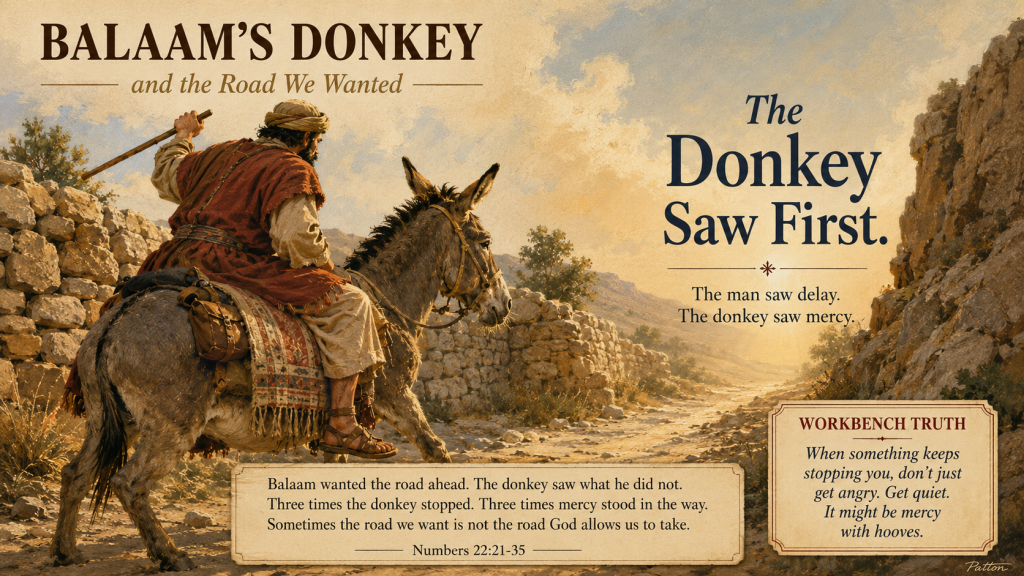

Sometimes the problem is not that the traditional lesson is wrong.
The problem is that we have become too familiar with it.
We hear “Balaam’s donkey,” and our minds go straight to the usual picture: stubborn animal, angry prophet, angel with a sword, and then the donkey talks. We remember the children’s class version. We remember the sermon title. We remember the punchline.
Sometimes we know a story so well that we stop listening to it.
It is like watching an old movie we have seen a dozen times. We start quoting the actor before he even says the line, and somehow we still get the words wrong. “Somehow.” Obviously, I forget to give it a little gas before releasing the clutch.
Scripture can do that to us if we are not careful. Not because Scripture has lost its power, but because we have sanded the sharp edges down in our own minds. We think, “I know this one,” and that may be the very moment we stop letting it examine us.
Balaam’s donkey is one of those stories. Yep, the donkey saw the angel, Balaam did not, and then the donkey spoke.
There it is, but maybe the talking donkey is not the strangest part of the story.
Maybe we are.
In Numbers 22, Balaam had already heard from God. This is important: God was not unclear. Balaam was told not to go with the men; the answer was given.
Balaam did what created people still do; he kept leaning toward the answer he wanted. Balaam did not need more revelation; he wanted revised permission.
That is where this story starts to step on our toes.
We come to God in prayer asking for this, that, and the other. Sometimes God does not answer the way we expected. Sometimes He says wait, sometimes He says no, and sometimes He points us in a direction we did not choose and would not have chosen.
We then, being created people and not always the sharpest tack in the box, start to push back.
We pout a little, stomp our feet, get angry, and point fingers. But “That’s not what I wanted.” Then we raise our voice: “That’s not what I wanted. You are not listening to me.”
“Why would You let this happen?” “Do You even care?” And that is when we need to be careful, very careful. We may have stopped praying and started judging.
We may be sitting at a desk, reviewing God’s actions like He has been called in for a performance evaluation.
Now before anyone gets wide-eyed and says, “How dare you write something like that,” slow down and hold up the mirror.
Have we never done it?
Have we never accused God by attitude, even if we cleaned up our words?
Have we never resented His timing?
Have we never treated His no like neglect?
Have we never acted as if His refusal meant He did not care?
The disciples did something like this in the boat during the storm. Jesus was right there with them, and yet fear opened its mouth.
“Teacher, do You not care that we are perishing?”
Mark 4:38, NKJV
There it is.
“Do You not care?” That question did not come from atheists; it came from disciples.
That ought to sober us.
Israel did it too. After everything God had done, after Egypt, after the sea, after deliverance, they still reached a hard place and asked the question:
“Is the LORD among us or not?”
Exodus 17:7, NKJV
Hardship made them reinterpret God’s faithfulness as absence, and that is dangerous ground.
Pain is not blasphemy, grief is not blasphemy, and crying out to God is not blasphemy.
The Psalms are full of honest cries. God can handle the trembling voice.
The danger comes when grief stops seeking God and starts cross-examining Him. Y’all, there is a difference between asking God for understanding and fighting God for control.
Paul wrote:
“But indeed, O man, who are you to reply against God?”
Romans 9:20, NKJV
Isaiah wrote:
“Woe to him who strives with his Maker!”
Isaiah 45:9, NKJV
That is not light language, and that is not a casual warning. That is the mirror catching us with the gavel in our hand.
Balaam’s problem was not that God had failed to speak. Balaam’s problem was that he wanted the answer changed. He wanted to keep moving toward what he desired, while still sounding spiritual enough to excuse it.
We can do the same thing.
We can bow our heads and say, “Lord, show me Your will,” while secretly demanding He approve ours.
That is not surrender.
That is a request form with religious ink. We ask God for direction, but sometimes what we really want is His signature on our plan.
That is Balaam’s road, and on that road, God placed a donkey.
The donkey turned aside into the field. Balaam struck her.
The donkey pressed against the wall and crushed Balaam’s foot. Balaam struck her again.
The donkey finally lay down under him. Balaam’s anger burned.
From Balaam’s view, the donkey was the problem.
From God’s view, the donkey was mercy.
That animal was not rebelling. She was seeing something Balaam could not see. She saw the angel of the Lord standing in the way with a drawn sword.
Balaam saw inconvenience; the donkey saw danger. Balaam saw embarrassment; the donkey saw death in the road.
That is where this story turns from strange to serious: often what we call delay may be protection.
Sometimes what we call resistance may be warning, and sometimes what we beat with our temper may be the very thing God is using to keep us from destruction.
The donkey was not in Balaam’s way; Balaam was in God’s way.
That ought to make us pause, because we have our own donkeys.
Closed doors.
Delayed answers.
Uncomfortable corrections.
People who tell us what we do not want to hear.
Circumstances that refuse to move.
Bodies that warn us.
Consequences that slow us down.
Scripture that cuts across our preference.
We call them obstacles because they do not cooperate with our plan.
But what if some of them are mercy?
What if the road is blocked because the road is dangerous?
What if God’s no is not cruelty?
What if the answer we did not want is the answer that keeps us alive spiritually?
That does not mean every hardship is easy to interpret. It does not mean every delay comes with a neat label tied to it. We are not God. We do not see the whole road. We do not see around the bend. We do not see the sword unless God opens our eyes.
That is the point, folks: we are created beings, dust with a pulse. And clay with coffee breath.
We are not seated above God.
We are not called to grade His wisdom.
We are not the judge, and He is not the defendant.
When we put God on trial, we have already stepped away from worship.
So maybe the course correction begins when we stop beating the donkey.
Maybe it begins when we pause long enough to ask, “Has God already spoken, and am I still trying to negotiate?”
That is a hard question. It does not flatter us, nor does it allow us to hide behind religious language.
Balaam had words about God, but his feet were still pointed toward what he wanted.
This is where we have to be honest with ourselves.
Have I turned prayer into a request form?
Have I started judging God because He did not answer the way I expected?
Have I mistaken correction for neglect?
Have I called mercy an obstacle because it bruised my pride?
The donkey was not Balaam’s enemy; the donkey was the interruption God used to stop him.
Sometimes the thing we are frustrated with may be the very thing God is using to stop us. That closed door is not rejection, and delay is not abandonment.
Sometimes the answer we did not want is still the answer we needed. The correction is not complicated, but it is not easy.
Put the gavel down and get out from behind the desk.
It is best we step away from the judge’s chair and return to the place of a servant.
Not my will, Lord. Yours.
Not my road, Lord. Yours.
Not my answer dressed up in prayer, Lord. Your answer, even when it humbles me.
Balaam finally saw what the donkey had seen all along.
The question for us is whether we will wait until our foot is crushed against the wall, or whether we will stop sooner and listen. The danger was never that the donkey stopped; the danger was that Balaam wanted to keep going.
That mirror I keep close at hand, right now I just can’t look at it. We know it’s bad when we convict ourselves.
Folks, if you received anything from this piece today, I invite you to attend your local Church of Christ and be sure to tell them Braxton sent you.