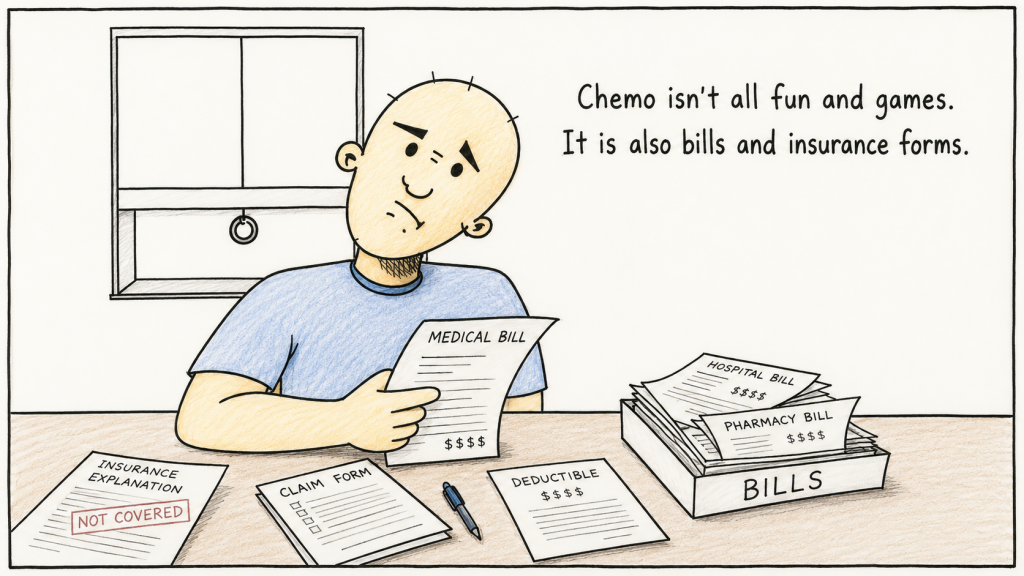
There is a part of the cancer journey that people do not talk about very much. It does not even have to be cancer. Any serious health crisis will do.
There are the bills.
In the beginning, there is fear and chaos. You wonder what will happen. You wonder whether you will live or die. That is a normal response.
Then the other side begins to creep in.
What if?
What will become of the family?
“Family unit” sounds too sterile for something so personal, but that thought kept returning between scans, chemotherapy, surgeries, and unscheduled physician visits.
There was the bank account. The checkbook. The balance that seemed to shrink while the stack of envelopes grew.
How will we cover this?
Then, slowly, the word “we” begins to change.
How will they cover this?
How will they pay the final bills? How will they manage burial expenses? What will I leave behind for them to sort through while they are already grieving?
These are questions no one wants to face.
But they are questions you have to face.
And then another question arrived:
What if I survive?
How will we pay all of these bills? Will I be able to return to work? Will my strength come back? Will the life I am fighting to keep still be waiting for me when treatment is over?
Spoiler alert: I was one of the lucky ones.
I lived.
I was able to continue working.
But in those early weeks and months, I did not know that ending yet. The questions kept circling long after the house went quiet. They sat beside me between scans, chemotherapy, surgeries, and appointments. They followed me into bed and kept watch through the night.
Sometimes survival was not the only thing I feared.
Sometimes I feared surviving into a life we could no longer afford.
Illness was not the only thing I dreaded. It was everything, nothing, and then everything again, all at once.
The envelopes kept coming.
Pay this.
Authorization denied.
And my personal favorite:
Resubmit.
As though the problem was not cancer, chemotherapy, surgery, fear, exhaustion, or money.
As though the problem was that I had filled out the wrong box.
Then my mind turned back toward death.
Death itself did not frighten me. Make no mistake, I wanted to live. But I had my faith, and when I could no longer hold my own hands up, faith held them for me.
Death, however, came with a cost.
I am not talking about the toll it would take on my family. That was obvious. It did not need explaining.
I mean the actual cost.
The funeral. The burial. The final medical bills. The accounts that would still demand payment after I was no longer there to open the envelopes.
Even dying had a price tag.
That realization carried its own kind of cruelty. I was fighting to stay alive while quietly calculating whether my family could afford for me not to.
Catastrophic illness comes with a price, and not only in the metaphorical sense. The cost is financial too.
That is the part people do not expect.
Everyone understands the fear, the pain, the treatments, and the possibility of loss. What often remains unseen is the steady financial weight pressing down through all of it.
It arrives quietly, one envelope at a time.
And it weighs heavily.
There were moments when there was nothing.
No clear thought. No plan. Only silence.
Then the dam would break, and every fear I had been holding back would come through at once.
The river of fear, doubt, and unanswered questions carried me along like debris. At times, I could not breathe.
That is when it is time to stop trying to do this alone.
Reach out to your spouse, your father, your mother, a sibling, a friend, or your minister.
You may think you are a fortress.
You are not.
None of us are.
We all build walls, but under enough pressure the mortar begins to crack. The bricks shift. The structure groans. Sometimes we need someone beside us, helping hold back the flood.
You may have thought this was going to be a piece about how to survive illness.
It is not.
It is permission to ask for help.
When the ship is taking on too much water and you can no longer keep bailing fast enough, stop pretending you can save it alone.
Ask for help.