The recent scare from “Big Salad” had, or still has, depending on when you read this piece, the world clutching its pearls.
If the scare is still current, exhale. We will make it through this. It is going to be all right.
Perhaps this is less a warning about lettuce and more a reminder that we have allowed the world to become too big, too centralized, and too dependent on everyone else.
Industrializing food, medication, transportation, and even housing has certainly made life easier. But perhaps it has made life a little too easy.
Think about it for a moment.
Over the past fifty or so years, daily life has become physically easier. Most of us no longer stand in a field with a hoe in our hands. We do not set traps for wild game or spend the day gathering what we hope will become supper.
Instead, we climb into an air-conditioned vehicle and make a short, climate-controlled foraging expedition to the local supermarket.
We stroll beneath fluorescent lights, place our harvest into a rolling metal basket, and complain when the checkout line has three people in it.
We get home and unload our haul from plastic bags that politely remind us to recycle.
We wipe down cans and bottles, then place them neatly in the pantry. We may even rinse our produce, towel-dry it, and place it in a crisper drawer designed to control temperature and moisture.
The old icebox has become a massive refrigerator, monitored and controlled by apps, sensors, and, dare I say it, artificial intelligence.
We have come a long way from digging a root cellar.
Now the refrigerator can tell us the door is open, the milk is low, and, perhaps one day soon, that we have no business reaching for another slice of pie.
We have come a long way from drying, smoking, salting, or fermenting our food.
Well, except for that unintentional science experiment growing in the Tupperware at the back of the refrigerator.
Life has become easier.
The Information Age has placed a computer in the palm of our hands, usually in the form of a glowing rectangle that may be sitting in yours right now.
Depending on how we use it, that little rectangle can be either a blessing or a curse.
For many people, it has become the modern town crier. Whatever appears on the screen is accepted as final, with little thought given to accuracy, context, or source.
It has spoken. That settles it.
Then fear spreads. Panic takes to the streets. Before long, one troubling headline has become ten warnings, twenty rumors, and a full-blown stampede toward the nearest freezer aisle.
This does at least two things to us physically.
First, it gives us a dopamine hit, feeding our dependence on technology and the endless cycle of checking, scrolling, refreshing, and reacting.
Second, it raises cortisol.
Our bodies respond as though the sky is falling yet again. The fight-or-flight system kicks in. Blood pressure rises. Heart rate increases. Even the way the body handles blood glucose can be affected.
All because a headline told us to panic.
So, have we truly made life easier?
Or have we simply traded the obvious terrors of the old world for quieter ones of our own creation?
Take a deep breath.
Inhale.
Now exhale.
Perhaps the answer is simpler than we think.
Maybe we need to stop allowing a twenty-four-hour news feed to decide when we should be frightened, angry, or afraid to eat lunch.
Let us put down the glowing rectangle for a while.
Let us pick up the fork, the hoe, or the rake. Let us take the first step and do the part that belongs to us.
We are living in a noisy time, but we do not have to listen to every sound.
We can question the headline.
We can check the source.
We can step outside.
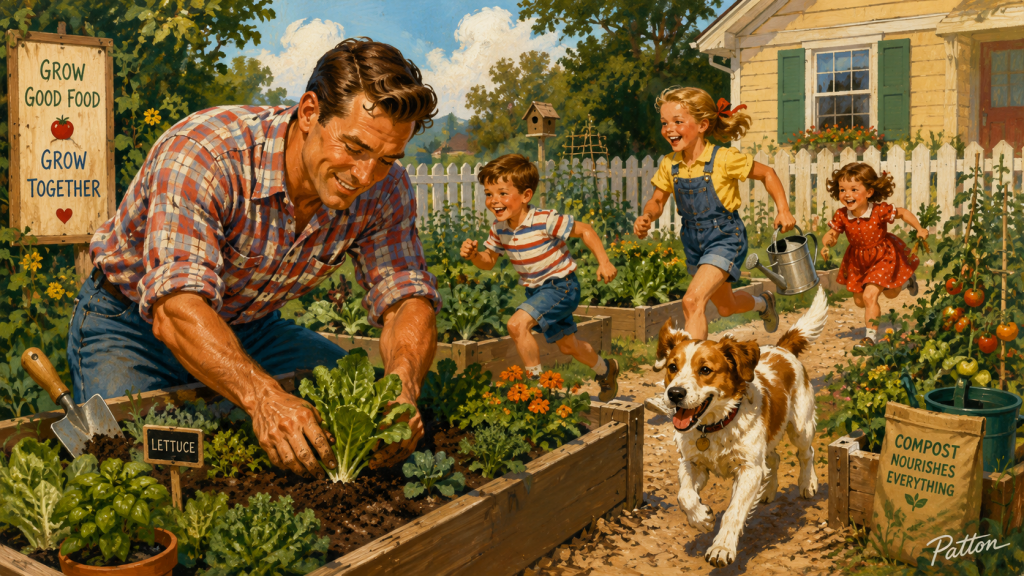
We can grow something, cook something, preserve something, or simply learn where our food comes from.
The noise may never stop.
But we can learn to filter it.